
Video from endress+hauser youtube official website
Why is dissolved oxygen sensor calibration necessary?
After long-term use, membrane aging, electrolyte depletion, or contamination in dissolved oxygen sensors can cause measurement drift. Regular calibration is key to ensuring data accuracy. Calibration can also extend sensor life and prevent process control errors caused by incorrect readings.
Preparation before calibration
Tools and materials
- Purified water or deionized water
- Soft cloth or paper towels
- Calibration solution (such as zero-oxygen solution)
- Standard instrument or portable dissolved oxygen meter (optional)
Environmental conditions
- Stable temperature, avoiding severe fluctuations
- No strong airflow or direct sunlight
- Sensor membrane clean, free of bubbles
Three calibration methods for dissolved oxygen sensors
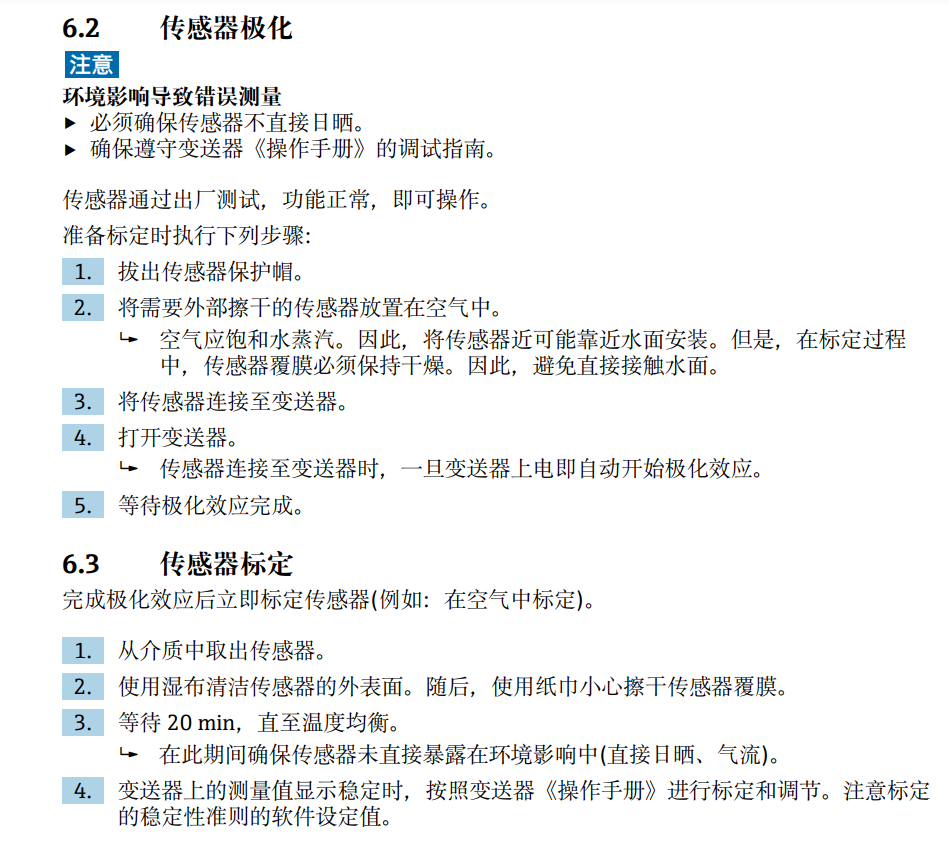
1. Air calibration (recommended for routine use)
Air calibration uses the known 20.9% oxygen concentration in air for single-point calibration. It is simple to operate and requires no additional reagents. It is suitable for most online dissolved oxygen sensors.
- Remove the sensor from water and gently wipe the membrane dry with a soft cloth.
- Place the sensor in air, ensuring there are no water droplets on the membrane surface.
- Wait for the reading to stabilize (usually 1-3 minutes), then enter the transmitter calibration menu and select "Air Calibration".
- Confirm the calibration value, then return the sensor to the water after completion.
2. Zero-point calibration (for low-concentration measurement)
Zero-point calibration uses an oxygen-free solution (such as sodium sulfite solution) to adjust the sensor reading to 0 mg/L. It is suitable for occasions where dissolved oxygen is measured near zero.
- Immerse the sensor in freshly prepared zero-oxygen solution and stir gently.
- Wait for the reading to stabilize (about 5-10 minutes) until the displayed value approaches 0.
- Select "Zero-point Calibration" in the transmitter and confirm to complete.
- Rinse the sensor with clean water to avoid contamination from residual solution.
3. Sample calibration (comparison method)
Sample calibration compares laboratory analysis or a portable meter with the online sensor and adjusts the slope or offset. It is suitable for high-precision requirements or verification of disputed data.
- Collect a water sample at the same time and determine the dissolved oxygen value by laboratory method.
- Record the difference between the online sensor reading and the laboratory value.
- Enter the laboratory value into the transmitter and execute "Sample Calibration".
- Repeat 2-3 times and take the average to ensure accuracy.
Comparison and selection of calibration methods
| Calibration method | Applicable scenario | Advantages | Disadvantages |
|---|---|---|---|
| Air calibration | Routine online monitoring | Fast, no reagents required | Affected by air pressure and humidity |
| Zero-point calibration | Low-concentration measurement | Improves zero-point accuracy | Requires preparation of oxygen-free solution |
| Sample calibration | High-precision verification | Reliable results | Time-consuming, depends on laboratory |
Calibration precautions and common issues
Key precautions
- Calibration cycle: It is recommended to perform air calibration every 1-2 weeks and zero-point calibration every 3-6 months.
- Membrane condition: If the membrane is damaged or contaminated, replace it before calibration.
- Temperature compensation: Ensure the transmitter temperature compensation function is turned on, otherwise calibration will be invalid.
- Avoid bubbles: Bubbles on the membrane surface will cause low readings and should be removed by gently flicking.
Common questions and answers
- What should I do if calibration fails? Check the membrane, electrolyte, and connecting cable, and replace the sensor if necessary.
- Why does the reading still drift after calibration? The electrolyte may be depleted and needs to be replenished or replaced.
- Can tap water be used for calibration? Not recommended. Dissolved oxygen in tap water is unstable; air calibration is recommended.
Summary
Correct dissolved oxygen sensor calibration is the core of ensuring measurement accuracy. Choose air calibration, zero-point calibration, or sample calibration according to the application scenario, and follow the standard steps. Regular maintenance and calibration can significantly improve sensor reliability and reduce operating and maintenance costs.