
Pressure Unit Conversion Table: A Guide to Common Pressure Unit Conversions
In industrial automation, instrument selection, and procurement, pressure unit conversion is a fundamental and high-frequency operation. Different countries and different devices often use different pressure measurement units, such as Pa, bar, psi, kgf/cm², etc. Incorrect conversion may lead to selection deviations or even safety hazards. This article provides a practical pressure unit conversion table and explains conversion methods and precautions in detail.
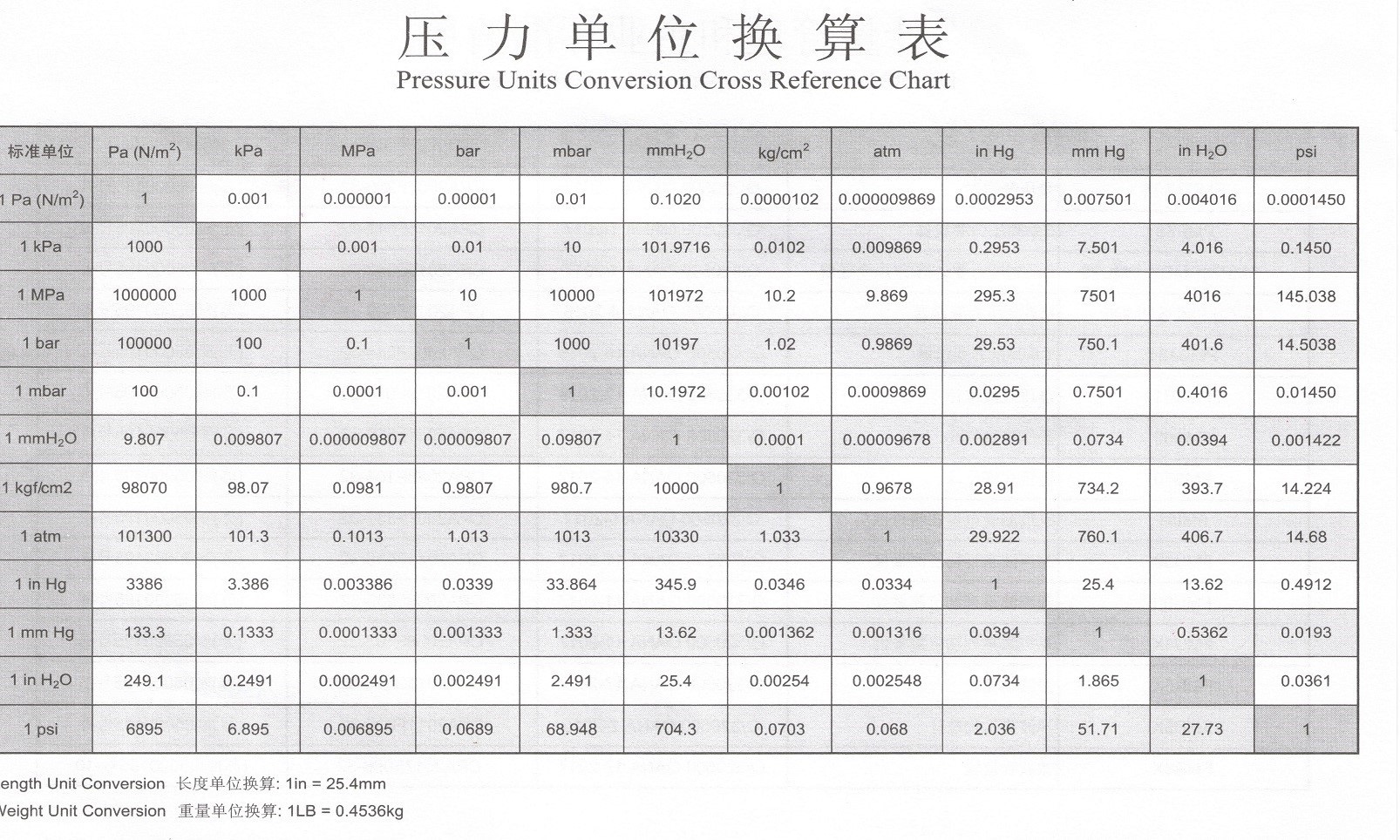
I. Overview of Common Pressure Units
In the International System of Units, the basic unit of pressure is the pascal (Pa), but in engineering sites, its multiples or non-legal units are more commonly used. Understanding the definitions and applicable scenarios of each unit helps in correctly selecting conversion relationships.
1. International System of Units Pressure Units
- Pa (pascal): 1 Pa = 1 N/m², the most basic pressure unit, commonly used in scientific experiments and low-pressure measurements.
- kPa (kilopascal): 1 kPa = 1,000 Pa, commonly used in HVAC, meteorology, and other fields.
- MPa (megapascal): 1 MPa = 1,000,000 Pa, most commonly used in industrial hydraulic and pneumatic systems.
2. Common Non-Legal Engineering Units
- bar: 1 bar = 100,000 Pa, a commonly used unit in European industrial standards.
- psi (pound-force per square inch): 1 psi ≈ 6,894.76 Pa, widely used in the United States and the United Kingdom.
- kgf/cm² (kilogram-force per square centimeter): 1 kgf/cm² ≈ 98,066.5 Pa, common in Asian engineering fields.
- mmH₂O, mmHg: represent millimeters of water column and millimeters of mercury, respectively, used for micro-pressure and vacuum measurement.
II. Pressure Unit Conversion Table
The table below lists conversion factors between common pressure units for quick reference. Using the first column as the base unit, multiply by the corresponding factor to obtain the target unit value.
| Base Unit | Pa | kPa | MPa | bar | psi | kgf/cm² |
|---|---|---|---|---|---|---|
| 1 Pa | 1 | 0.001 | 1×10⁻⁶ | 1×10⁻⁵ | 1.45038×10⁻⁴ | 1.01972×10⁻⁵ |
| 1 kPa | 1,000 | 1 | 0.001 | 0.01 | 0.145038 | 0.0101972 |
| 1 MPa | 1,000,000 | 1,000 | 1 | 10 | 145.038 | 10.1972 |
| 1 bar | 100,000 | 100 | 0.1 | 1 | 14.5038 | 1.01972 |
| 1 psi | 6,894.76 | 6.89476 | 0.00689476 | 0.0689476 | 1 | 0.070307 |
| 1 kgf/cm² | 98,066.5 | 98.0665 | 0.0980665 | 0.980665 | 14.2233 | 1 |
Note: The conversion factors in the table above are calculated based on standard gravity acceleration (9.80665 m/s²) and are applicable to most engineering scenarios.
III. Pressure Unit Conversion Methods
If a conversion table is not available, manual conversion can also be performed using basic formulas. The following steps are applicable to conversions between any units.
1. Conversion Steps
- Determine the original value and unit, for example 2.5 MPa.
- Find or calculate the conversion factor between the original unit and the target unit. For example, for MPa to psi, the factor is 145.038.
- Multiply the original value by the conversion factor: 2.5 × 145.038 = 362.595 psi.
- Retain decimal places according to precision requirements; generally, 2–3 decimal places are retained in engineering calculations.
2. Common Conversion Formulas
- MPa → bar: value × 10
- bar → psi: value × 14.5038
- psi → kPa: value × 6.89476
- kgf/cm² → bar: value × 0.980665
- mmH₂O → Pa: value × 9.80665
IV. Conversion Precautions and Selection Recommendations
Pressure unit conversion may seem simple, but in instrument selection and procurement, ignoring details can cause range mismatch or reading errors. The following points require special attention.
- Distinguish gauge pressure from absolute pressure: Gauge pressure uses atmospheric pressure as a reference, while absolute pressure uses vacuum as zero. They cannot be directly mixed in conversion; the atmospheric pressure value (about 101.325 kPa) must be added or subtracted.
- Pay attention to the case of unit symbols: MPa and mPa differ by 10⁹ times; a typo may lead to serious errors.
- Leave margin in the range: When selecting, it is recommended that the actual working pressure be between 1/3 and 2/3 of the instrument range, and pressure peaks should be considered.
- Verify the source of standards: Different industry standards (such as ISO, ASTM, GB) may have slight differences in unit definitions; confirm before procurement.
- Use conversion tools: It is recommended to use online pressure unit converters or mobile apps to reduce manual calculation errors.
Mastering the pressure unit conversion table and conversion methods can significantly improve engineering design and procurement efficiency. It is recommended to save this table for future reference and double-check key parameters to ensure safe and reliable system operation.