
1. Commissioning Operation Instructions
Before commissioning the COM223/COM253 dissolved oxygen transmitter, you need to become familiar with the functions of each operating key. The keys are described below:
- CAL key: Calibration, activates calibration mode and displays the calibration menu.
- + key / - key: Numerical increment / numerical decrement.
- E key: Confirm key.
- REL1: Manual relay operation key; the other key is the relay manual/auto toggle key.
- REL2: Relay 2 operation key (functions similar to REL1).
2. Probe Inspection and Calibration
Install the membrane cap filled with electrolyte on the probe, expose it to air, and be careful not to expose the probe directly to sunlight. The suitable temperature should be between 20°C and 25°C. Connect the secondary meter, press the CAL key, and the password is 22. Select air calibration, press the E key to confirm. At this point the displayed value starts dropping from 600 all the way to zero. If there is no fault code, calibration is complete.
After calibration is complete, check whether the displayed values are normal:
- Altitude displayed value: 6.00 to 11.20 mg/l or 85 to 157%SAT is normal.
- Salinity displayed value: 9.20 to 9.30 mg/l or 102%SAT is normal.
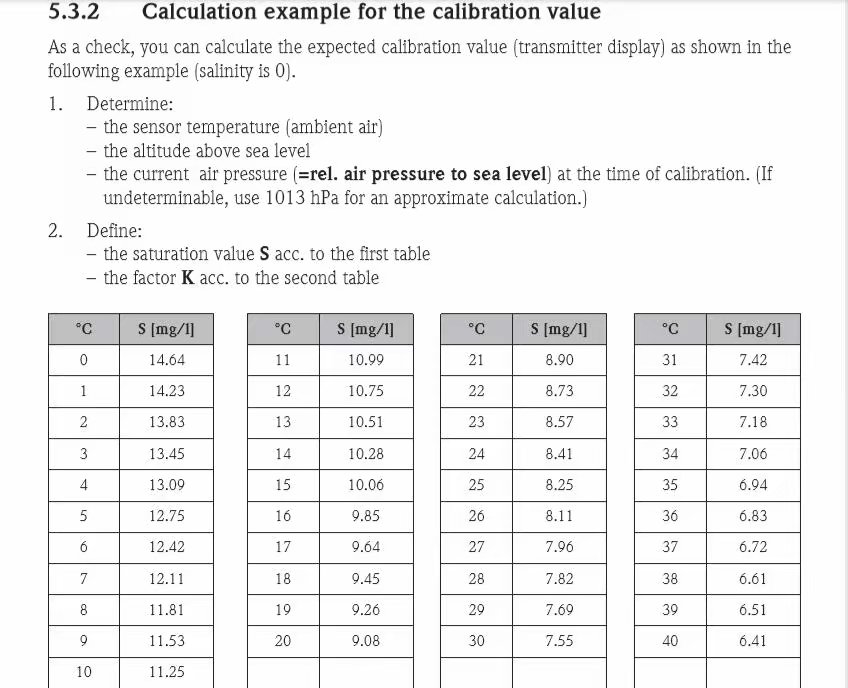
The figure below shows the dissolved oxygen calibration values in air:
3. Range Setting Procedure
1. Unit setting (select mg/L)
- Main screen → press E → code0 → press "+" until 22 → press E → Setup1 → press E → Unit → press "+" or "-" → select mg/L → press E.
2. Output range setting (4-20mA)
- Main screen → press E → code0 → press "+" until 22 → press E → press "-" twice → output → press E twice, select 4-20mA → press E → set the value corresponding to 4mA → press E → set the value corresponding to 20mA → press E.
4. Installation and Maintenance Precautions
The dissolved oxygen probe should be gently cleaned with water regularly every week. If the membrane cap is found to be damaged, it should be replaced promptly. If the electrolyte is contaminated, it should also be replaced promptly. In addition, the probe cable should not be subjected to stress.
Dissolved oxygen poses no problems in municipal wastewater, but in industrial wastewater its composition must be clearly identified; otherwise, the membrane cap is easily damaged. H2S, ammonia, benzene, and phenol are harmful to the membrane cap. In such applications, the membrane cap must be replaced frequently.
5. Key Parameters Quick Reference Table
| Item | Normal Range | Remarks |
|---|---|---|
| Altitude displayed value | 6.00-11.20 mg/L or 85-157%SAT | Check after air calibration |
| Salinity displayed value | 9.20-9.30 mg/L or 102%SAT | Check after air calibration |
| Calibration password | 22 | Enter calibration menu |
| Maintenance interval | Weekly cleaning | Replace immediately if membrane cap is damaged or electrolyte is contaminated |