
E+H Residual Chlorine Analyzer System Overview
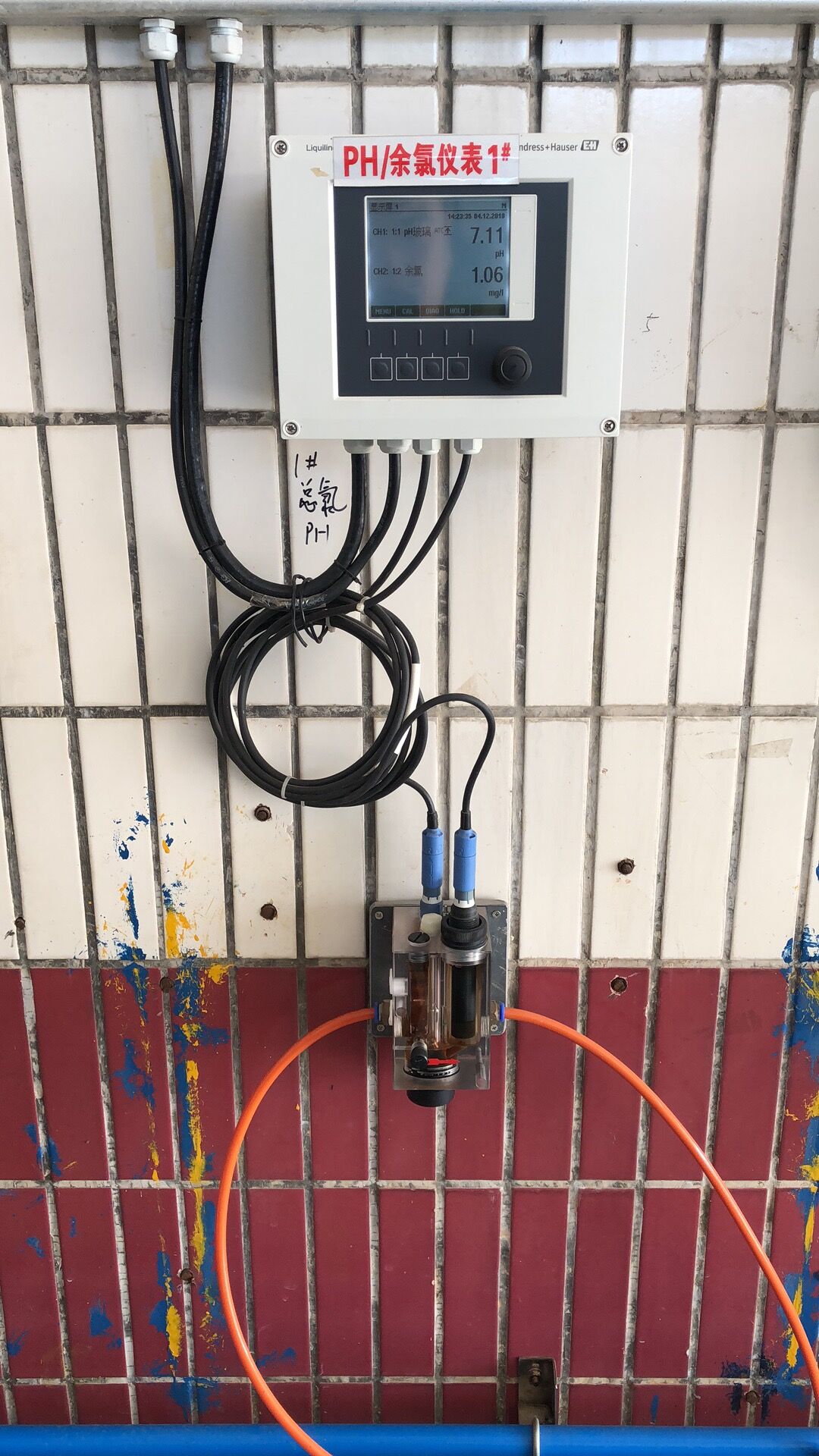
The E+H residual chlorine analyzer is a commonly used online monitoring device in sodium hypochlorite disinfection processes at water treatment plants and wastewater treatment plants. The system consists of a CM442 transmitter, CCS51D residual chlorine sensor, CPS31D pH sensor, and CCA250 flow cell. The following installation diagram shows the complete wall-mounted flow-through installation solution.
Core Components and Selection Configuration
Transmitter and Sensor Models
- Transmitter: CM442-*M2*, multi-channel transmitter, supports simultaneous residual chlorine and pH measurement.
- Residual chlorine sensor: CCS51D, membrane-covered amperometric sensor, measures hypochlorous acid concentration.
- pH sensor: CPS31D, digital pH sensor, used to compensate for the pH dependence of residual chlorine measurement.
- Flow cell: CCA250, wall-mounted flow cell, ensures stable sensor installation and sample water flow.
Typical Application Scenarios
- Online residual chlorine monitoring after sodium hypochlorite disinfection at water treatment plants.
- Residual chlorine control for sodium hypochlorite disinfection at wastewater treatment plant discharge outlets.
- Chlorination disinfection processes requiring simultaneous monitoring of residual chlorine and pH.
Installation Method and Steps
This system adopts wall-mounted flow-through installation, with sensors fixed to the wall via the CCA250 flow cell, and sample water flowing continuously through the flow cell. During installation, ensure stable sample water flow without bubbles and avoid direct sunlight.
- Fix the CCA250 flow cell to the wall or bracket, maintaining vertical or horizontal installation orientation in accordance with the manual requirements.
- Connect the sample water inlet and outlet pipes, ensuring the inlet pressure is within the allowable range of the flow cell.
- Insert the CCS51D residual chlorine sensor and CPS31D pH sensor into the corresponding ports of the flow cell and tighten them securely.
- Connect the sensor cables to the corresponding channels of the CM442 transmitter, paying attention to matching the markings.
- Turn on the power and check whether the transmitter display and sensor signals are normal.
- Introduce sample water, adjust the flow rate to the recommended value, remove bubbles, and then proceed with calibration.
Key Parameters and Comparison
| Component | Model | Key Parameters/Functions |
|---|---|---|
| Transmitter | CM442-*M2* | Multi-channel, supports residual chlorine and pH inputs, outputs 4-20mA/relay |
| Residual chlorine sensor | CCS51D | Measuring range 0-5 mg/L, membrane amperometric, fast response |
| pH sensor | CPS31D | Digital, measuring range 0-14 pH, used for residual chlorine compensation |
| Flow cell | CCA250 | Wall-mounted, PVC material, suitable for sample water temperature 0-50℃ |
Maintenance and Precautions
- Regularly check whether the CCS51D sensor membrane is contaminated or damaged, and replace the electrolyte and membrane cap if necessary.
- Regularly calibrate the CPS31D pH sensor with standard solutions to ensure accurate residual chlorine measurement.
- Keep the CCA250 flow cell clean to prevent clogging by algae or particulate matter.
- If the transmitter displays abnormalities, first check the sensor connections and sample water flow, then investigate sensor lifespan.