
Why is there a large difference between online and static resistivity measurements of ultrapure water?
In ultrapure water systems, online flow-through resistivity measurement often shows 12-18 MΩ·cm, but when sampled into a glass beaker and measured statically, the value rapidly drops to 6-7 MΩ·cm. This difference is not an instrument fault, but a physicochemical process caused by changes in measurement conditions. Understanding these mechanisms helps in the correct selection and installation of online instruments.
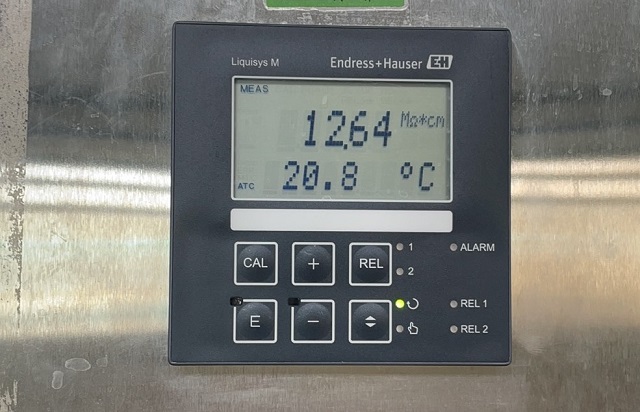
Core reasons: CO₂ dissolution and container contamination
1. CO₂ dissolution from air
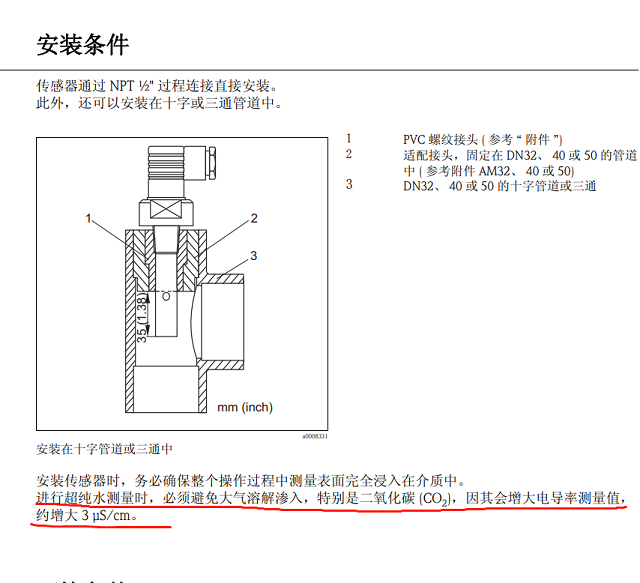
When ultrapure water is exposed to air, CO₂ rapidly dissolves and ionizes into H⁺ and HCO₃⁻, increasing conductivity and decreasing resistivity. This is the main reason for the low static measurement value.
2. Ion release from glass beaker
The surface of glass containers will dissolve sodium, silicon and other ions, further increasing conductivity. Even with high-purity glass, contamination cannot be completely avoided.
3. Differences in flow state
During online measurement, the water sample continuously flows, which can suppress CO₂ dissolution and reduce container contamination; during static measurement, the water sample is stationary, and the contamination accumulation effect is significant.
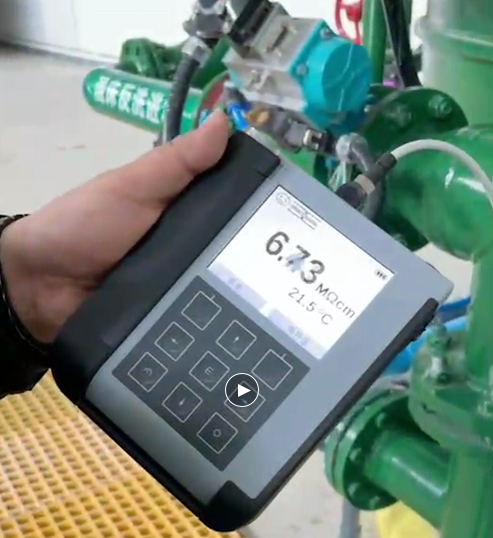
How to correctly measure ultrapure water resistivity?
To ensure measurement accuracy, the following principles should be followed:
- Flow-through installation: The resistivity sensor must be installed in a flow cell to maintain continuous flow of the water sample.
- Vacuum or inert gas protection: Avoid contact of the water sample with air to prevent CO₂ dissolution.
- Use stainless steel or PFA containers: Avoid ion release from glass containers.
- Rapid measurement: Measurement should be completed within 30 seconds after sampling to reduce air contact.
Comparison of online and static measurement
| Measurement method | Typical resistivity | Main influencing factors | Applicable scenarios |
|---|---|---|---|
| Online flow-through | 12-18 MΩ·cm | Flow state, vacuum degree | Continuous monitoring of ultrapure water systems |
| Static sampling | 6-7 MΩ·cm | CO₂ dissolution, container contamination | Temporary spot checks (not recommended) |
Conclusion and recommendations
Ultrapure water resistivity measurement must use online flow-through installation and ensure the pipeline is sealed with vacuum or inert gas. Static glass beaker measurement is only suitable for rough judgment and cannot be used as a basis for water quality qualification. AYI Technology is your process automation instrument expert by your side, providing professional ultrapure water resistivity measurement solutions.