
E+H Dissolved Oxygen Sensor Selection Overview
E+H (Endress+Hauser) offers a variety of dissolved oxygen sensors, covering a wide range of working conditions from wastewater treatment to biopharmaceuticals. Among them, COS41, COS51D, and COS61D are the three most common models in industrial sites.
The core of selection lies in clarifying the measurement range, process connection, hygiene level, and maintenance method. This article uses technical information comparison to help engineering technicians and procurement quickly lock in the appropriate model.
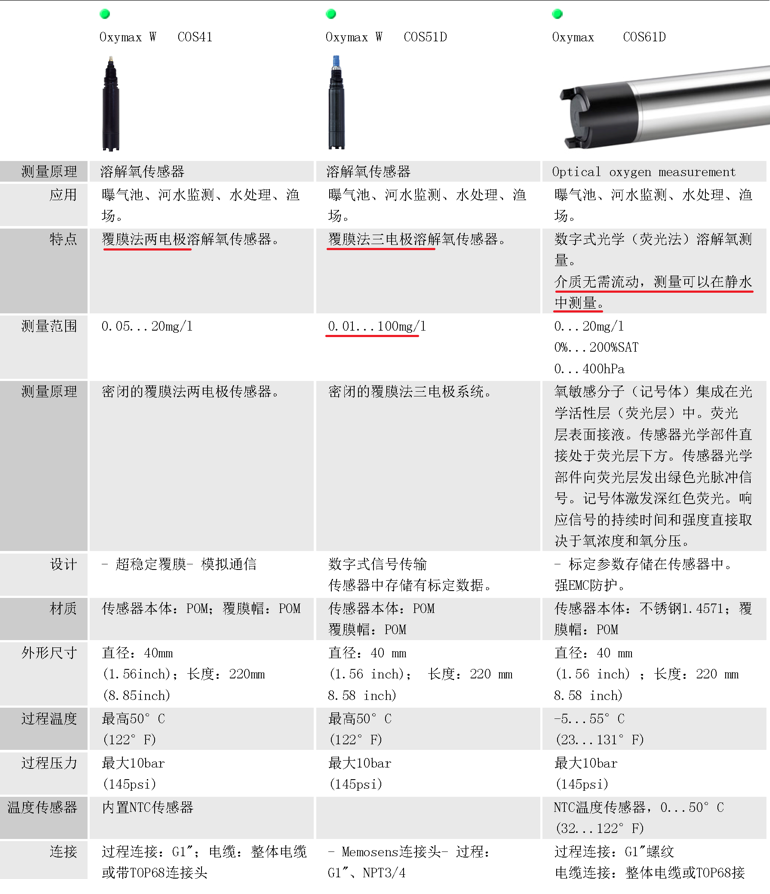
Core Positioning of the Three Sensors
COS41: General-Purpose Optical Dissolved Oxygen Sensor
COS41 uses the fluorescence method (optical) measurement principle, requiring no electrolyte or membrane, with low maintenance. It is suitable for conventional working conditions such as wastewater treatment and surface water monitoring.
Its measurement range is typically 0~20 mg/L, supporting immersion or flow-through installation. For scenarios requiring low maintenance and contamination resistance, COS41 is an economical and practical choice.
COS51D: Digital Optical Dissolved Oxygen Sensor
COS51D is a digital sensor using Memosens technology, supporting plug-and-play and laboratory calibration. The measurement range can cover 0~20 mg/L, with some versions extendable to higher concentrations.
It is suitable for the chemical, pharmaceutical, and food and beverage industries, especially for occasions requiring frequent calibration or remote diagnostics. Digital signal transmission has strong anti-interference capability, suitable for long-distance wiring.
COS61D: Hygienic Digital Optical Dissolved Oxygen Sensor
COS61D is designed specifically for hygienic applications. Its wetted materials meet FDA and EHEDG requirements and support CIP/SIP cleaning. The measurement range is typically 0~20 mg/L with high accuracy.
Typical applications include bioreactors, fermentation tanks, and water for injection systems. Its hygienic process connections (such as Tri-Clamp, Varivent) ensure reliable sealing under aseptic conditions.
Comparison of Key Technical Parameters
| Parameter | COS41 | COS51D | COS61D |
|---|---|---|---|
| Measurement Principle | Fluorescence (Optical) | Fluorescence (Digital) | Fluorescence (Digital) |
| Measurement Range | 0~20 mg/L | 0~20 mg/L (Extendable) | 0~20 mg/L |
| Signal Output | Analog/Digital | Memosens Digital | Memosens Digital |
| Process Connection | Immersion/Flow-through | Various Process Connections | Hygienic (Tri-Clamp, etc.) |
| Hygiene Level | Standard | Standard/Hygienic Optional | FDA/EHEDG Hygienic |
| Typical Industries | Wastewater, Surface Water | Chemical, Pharmaceutical, Food | Biopharmaceutical, Fermentation |
Selection Steps and Key Points
Select Sensor by Working Condition
- Confirm Measurement Range: If dissolved oxygen concentration is below 0.1 mg/L for a long time, choose a high-precision model such as COS61D; for conventional wastewater, COS41 is sufficient.
- Confirm Process Connection: Hygienic conditions must use COS61D; general industrial pipelines can use COS51D or COS41.
- Confirm Signal Type: For digital communication and remote calibration, prioritize COS51D or COS61D; if only analog output is needed, COS41 is sufficient.
- Confirm Maintenance Strategy: Optical sensors are all electrolyte-free, but COS61D supports CIP/SIP, suitable for frequent cleaning occasions.
Selection Precautions
- The response time of optical sensors is affected by temperature; confirm the process temperature range.
- For hygienic applications, verify the wetted material certificates and seal compatibility.
- Digital sensors need to be paired with corresponding transmitters (such as the Liquiline series).
- The installation location should avoid bubble accumulation and direct strong light to ensure measurement representativeness.
Conclusion
When selecting E+H dissolved oxygen sensors, COS41 is suitable for conventional water treatment and low-maintenance scenarios; COS51D is suitable for industrial processes requiring digital communication and flexible calibration; COS61D is the first choice for hygienic and high-precision applications.
It is recommended to make a final confirmation based on actual working condition parameters and procurement budget, combined with the comparison results in the table above, and consult E+H technical support for selection software assistance if necessary.