
TMT180 Temperature Transmitter Wiring Overview
The TMT180 is a commonly used temperature transmitter, and its wiring method varies depending on the RTD type. The power supply is 2-wire 10-35VDC, with terminal 1 as + and terminal 2 as -. Please note: The TMT180 can only be connected to RTDs, not thermocouples. The wiring methods for different RTDs are described below.
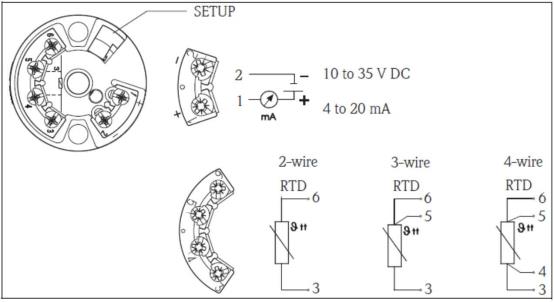
Power Supply Wiring
The TMT180 uses a 2-wire power supply with a voltage range of 10-35VDC. When wiring, connect the positive power supply to terminal 1 and the negative to terminal 2. Ensure correct power polarity to avoid damaging the transmitter.
RTD Wiring Methods
Depending on the RTD wiring configuration, the connection methods are divided into 2-wire, 3-wire, and 4-wire. Please select the corresponding wiring based on the actual RTD type used.
2-Wire RTD
The wiring for a 2-wire RTD is the simplest; simply connect the two leads of the RTD to terminals 3 and 6 respectively.
3-Wire RTD
A 3-wire RTD can effectively eliminate the effect of lead resistance. When wiring, connect one end of the RTD to terminal 3, and the two leads from the other end to terminals 5 and 6 respectively.
4-Wire RTD
A 4-wire RTD offers the highest accuracy and is suitable for high-precision measurements. When wiring, connect the two wires from one end of the RTD to terminals 3 and 4, and the two wires from the other end to terminals 5 and 6.
Wiring Precautions
- It is strictly prohibited to connect a thermocouple to the TMT180; otherwise, it will cause measurement errors or equipment damage.
- Before wiring, confirm that the power supply voltage is within the 10-35VDC range and ensure correct polarity.
- When using a 3-wire or 4-wire RTD, ensure that the lead resistances are equal to minimize measurement errors.
- After wiring, check that all terminals are tightened to avoid loose connections.
Summary
The wiring method of the TMT180 temperature transmitter depends on the RTD wiring configuration. 2-wire connects to 3 and 6, 3-wire connects to 3, 5, and 6, and 4-wire connects to 3, 4, 5, and 6. Correct wiring is key to ensuring measurement accuracy; please follow the above methods carefully.