
Temperature Transmitter TMT162 Wiring Overview
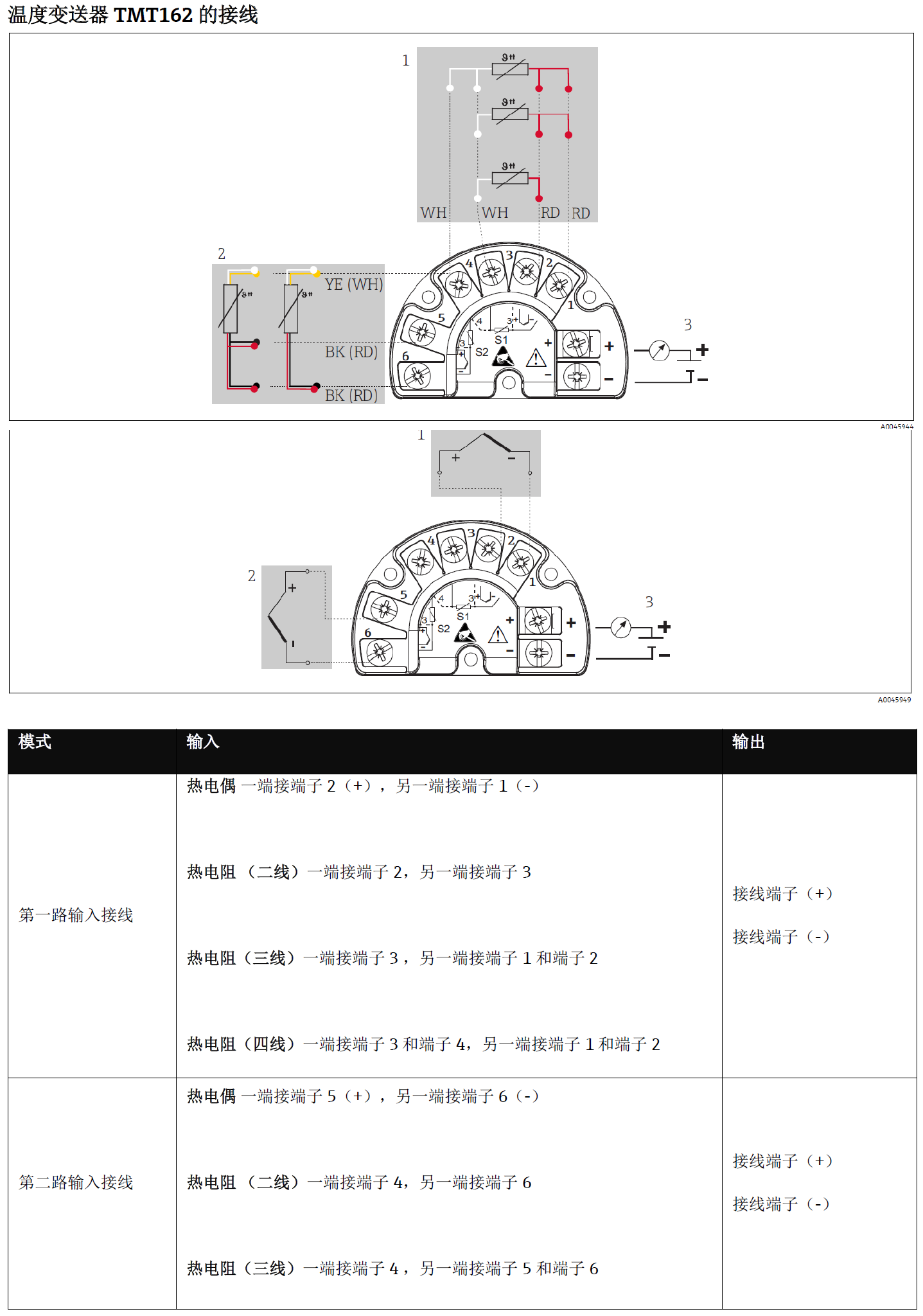
The temperature transmitter TMT162 supports two input types: thermocouple and RTD. Correct wiring is the first step to ensure measurement accuracy and stability. The wiring methods are introduced below.
Thermocouple Wiring Method
Thermocouple wiring is relatively simple; only two wires need to be connected. The specific steps are as follows:
- Connect the positive pole of the thermocouple to terminal 2 (+).
- Connect the negative pole of the thermocouple to terminal 1 (-).
Note that the polarity must not be reversed, otherwise measurement errors will occur.
RTD Wiring Method
RTDs differ in wiring depending on the wire configuration. Common types include two-wire, three-wire, and four-wire.
Two-Wire RTD
- Connect one end of the RTD to terminal 2.
- Connect the other end to terminal 3.
Two-wire wiring is simple, but the lead resistance introduces errors, making it suitable for applications with low accuracy requirements.
Three-Wire RTD
- Connect one end of the RTD to terminal 3.
- Connect the other end to terminal 1 and terminal 2 (these must be shorted).
Three-wire wiring compensates for lead resistance and improves measurement accuracy, making it a commonly used method in industrial sites.
Four-Wire RTD
- Connect one end of the RTD to terminal 3 and terminal 4.
- Connect the other end to terminal 1 and terminal 2.
Four-wire wiring completely eliminates the effect of lead resistance and offers the highest accuracy, making it suitable for high-precision measurements.
Terminal Definitions and Comparison
For easy reference, the table below summarizes the terminal assignments for different sensor types.
| Sensor Type | Terminal 1 | Terminal 2 | Terminal 3 | Terminal 4 |
|---|---|---|---|---|
| Thermocouple | - | + | — | — |
| RTD (two-wire) | — | One end | Other end | — |
| RTD (three-wire) | One end | One end | Other end | — |
| RTD (four-wire) | One end | One end | Other end | Other end |
Wiring Precautions
- Before wiring, confirm that the transmitter power supply is disconnected.
- Use a suitable screwdriver to tighten the terminals to avoid loose connections.
- Thermocouples require compensation wires; RTDs are recommended to use three-wire or four-wire configurations.
- After wiring is completed, check for correctness before energizing.
Following the above methods ensures the stable operation of the TMT162 temperature transmitter and obtains accurate temperature signals.