
Working Principle of Ultrasonic Flowmeter
An ultrasonic flowmeter is a non-contact flowmeter, whose core principle utilizes the characteristic that ultrasonic waves are affected by flow velocity when propagating through a fluid. By measuring the propagation speed of ultrasonic waves in the fluid, the fluid flow velocity can be detected and converted into flow rate. This method does not disturb the flow field and is suitable for various industrial occasions.
Transit-Time Measurement Principle
The most widely used type is the transit-time ultrasonic flowmeter. When ultrasonic waves propagate in a fluid, the propagation speed in the downstream direction increases, while the propagation speed in the upstream direction decreases. Over the same propagation distance, downstream and upstream propagation produce different travel times.
By utilizing the relationship between the difference in downstream and upstream propagation speeds and the measured fluid flow velocity, the flow velocity can be determined and converted into flow rate. This method has high measurement accuracy and good adaptability to clean liquids and gases.
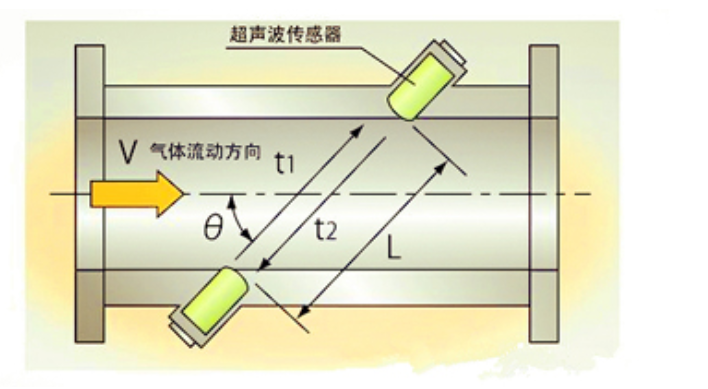
Structural Composition of Ultrasonic Flowmeter
An ultrasonic flowmeter is generally divided into three main parts: field sensors (probes), transmission cables, and display host. Each part works together to complete signal transmission, transmission, and flow calculation.
Sensor Types
- Clamp-on: Clamped on the outer wall of the pipe, easy to install, no contact with fluid.
- Insertion: Probe inserted into the pipe, suitable for larger pipe diameters.
- Flanged (spool piece): Connected to pipe flanges, high measurement accuracy.
Display Host Types
- Fixed: Long-term online monitoring, suitable for industrial sites.
- Portable: Convenient for mobile inspection and temporary measurement.
Installation Requirements for Ultrasonic Flowmeter
The installation location directly affects measurement accuracy. A certain length of straight pipe section must first be selected, i.e., a pipe section with uniform fluid distribution to reduce measurement errors.
- Confirm that the fluid in the pipe is full and the flow state is stable.
- Avoid disturbance sources such as valves, elbows, and pumps to ensure sufficient straight pipe section.
- Correctly fix the probe according to the sensor type to ensure good coupling.
Comparison of Selection and Installation Points
| Item | Clamp-on | Insertion | Flanged |
|---|---|---|---|
| Installation Method | Clamped on pipe outer wall | Inserted into pipe | Flanged connection |
| Applicable Pipe Diameter | Small to medium diameter | Large diameter | Small to medium diameter |
| Measurement Accuracy | Relatively high | High | High |
| Maintenance Convenience | Convenient | Requires flow stop | Requires flow stop |
In summary, reasonably selecting the sensor type and meeting the straight pipe section installation requirements are key to ensuring the long-term stable operation of the ultrasonic flowmeter.