
The 7F2C is a universal multifunctional flowmeter equipped with wet steam detection function, featuring the highest measurement accuracy. It is particularly suitable for the measurement of wet steam/saturated steam/superheated steam, gases, and liquids (as well as low-temperature media). Some optimizations have been made for steam measurement, improving measurement accuracy.
For the 7F2C flowmeter, the installation of the pressure sensor is relatively flexible, the display module has data transmission function, and it has passed multiple international certifications. Its housing is dual-chamber, robust, durable, and highly safe. The device has high integration, with built-in temperature and pressure measurement devices for steam and gases, and comes with straight pipe section compensation function, which can save some space. It is also the vortex flowmeter with the highest linearity; when the Reynolds number is not less than Re10000, the measurement accuracy remains constant. The wiring of the device is also very convenient, and operation is very safe. It also features a heartbeat verification function.
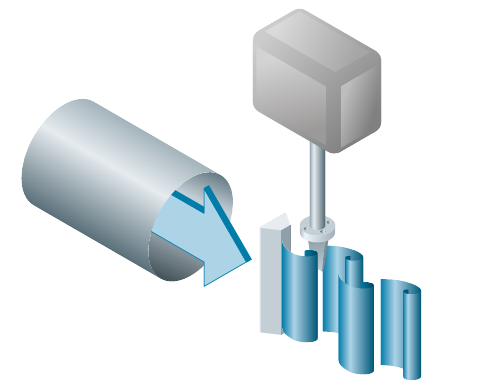
Next, let us introduce the measurement principle of this vortex flowmeter, which is based on the Karman vortex street principle. When fluid passes the bluff body, vortices alternately appear on both sides, and the rotation directions of the vortices on the two sides are opposite. Each vortex generates a low-pressure zone; the sensor detects pressure changes and converts them into electrical pulse signals. Within the allowable range of the flowmeter, vortices are generated regularly. Therefore, the vortex frequency is proportional to the volumetric flow rate. The figure shows a schematic diagram of the vortex flowmeter measurement principle.
The calibration coefficient is a proportionality constant, whose value is pulses divided by volume unit. Within the allowable range of the flowmeter, the K factor depends only on the geometric structure of the flowmeter. The main measurement signal is linearly related to the flow rate. The K factor is determined by calibration before leaving the factory, so there is no long-term drift or zero drift. The device has no moving parts and requires no maintenance.
The vortex flowmeter uses a capacitive sensor and has passed burst testing, vibration resistance testing, and temperature shock resistance testing (150 K/s thermal shock). Measurement performance, reliability, and structural stability are guaranteed to a certain extent.
The flowmeter measures temperature via a Pt 1000 temperature sensor. The temperature sensor is installed on the DSC sensor shaft, so it directly contacts the measured liquid.
For volumetric flow measurement, the materials of the DSC sensor and measuring tube can be selected as 316L or Alloy C22, and they can also withstand high temperatures. For mass flow measurement, temperature measurement is also built in, i.e., temperature compensation.
It is worth noting that only HART-type instruments can have the sensor type option of mass flow, with built-in pressure/temperature measurement. Select the option code steam mass flow or gas/liquid mass flow. Measuring devices with this option can measure the pressure and temperature of the fluid. The flowmeter can directly measure pressure at a position close to the bluff body in the instrument. The selected pressure tapping point should be able to measure both pressure and temperature simultaneously. This ensures high-precision fluid density and/or energy compensation based on pressure and temperature. The pressure measurement value is slightly lower than the pipeline pressure. Therefore, Endress+Hauser provides pipeline pressure correction (built into the device).
After recalibration, the measuring device still has high stability, fully consistent with factory calibration. The parameter values after recalibration are all within the specified measurement accuracy range of the flowmeter. This applies to volumetric flow measurement values, i.e., the main measurement variable of the device.
The upstream straight pipe section length correction function can shorten the required upstream straight pipe section length; it is only necessary to ensure that the upstream straight pipe section length is not less than 10 × DN. If the upstream straight pipe section is too short, the flowmeter can correct the resulting measurement error, but it is related to the degree of change in the flow field morphology caused by the throttling device installed in the upstream pipeline.
The measuring device can calculate the density and energy of air and industrial gases. The calculation is based on practically verified standard calculation methods. Pressure and temperature effects can be automatically compensated via external values or constant values. It can also measure single, mixed, and air, etc. It can also calculate the chemical properties of natural gas, such as gross calorific value, net calorific value, etc.
A device consists of a transmitter and a sensor. The compact type is a mechanical unit composed of the transmitter and sensor as a whole. The remote type has the transmitter and sensor installed separately. Below are schematic diagrams of the transmitter and sensor.
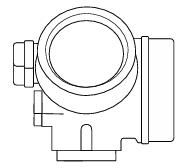
Transmitter
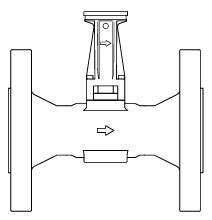
Sensor
There are also many choices for the transmitter and sensor, which will not be repeated here.