
Prosonic 91 Installation Guide
Correct installation of the Prosonic 91 ultrasonic flowmeter is key to ensuring measurement accuracy. This article provides a detailed introduction to installation location, orientation, straight pipe length requirements, and sensor selection, helping engineering and procurement personnel quickly master installation specifications.
1. Installation Location
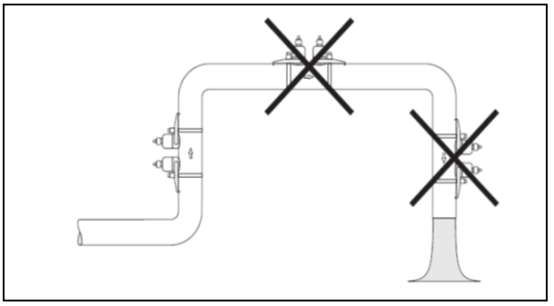
The choice of installation location directly affects measurement accuracy. Ensuring the measuring pipe is in a full-pipe state is a prerequisite for correct flowmeter measurement. Install the sensor on an upward pipe whenever possible.
Note! When gas accumulation or bubble formation occurs in the measuring pipe, measurement error will increase. Therefore, avoid the following installation locations:
- The highest point of the pipe: prone to gas accumulation.
- Directly above a downward draining pipe: prone to non-full-pipe conditions.
2. Installation Orientation
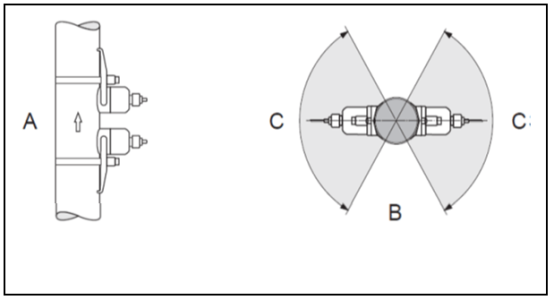
The installation orientation depends on the pipe routing. Correct selection can avoid interference from gas and sediment.
Vertical Pipe
It is recommended to choose a pipe with fluid flowing from bottom to top (View A). In this orientation, when the fluid is stationary, solid media sink and gas rises, away from the sensor. The pipe can be fully self-draining, and no solid adhesion will occur.
Horizontal Pipe
It is recommended to install within the area shown in View B to avoid gas and air accumulation at the top of the pipe, while also reducing the impact of sediment at the bottom of the pipe on measurement.
- A: Recommended installation orientation, fluid flowing upward.
- B: Recommended installation range in horizontal pipes.
- C: Recommended installation angle, maximum 120°.
3. Upstream and Downstream Straight Pipe Lengths
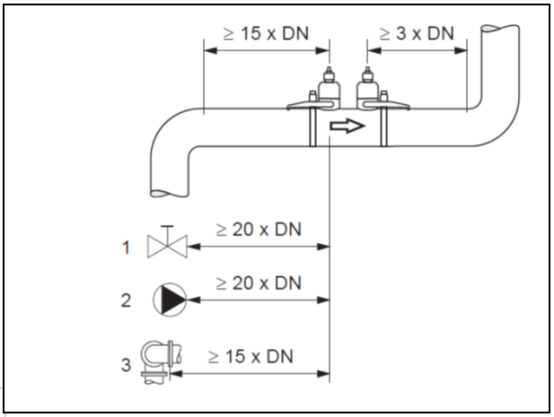
The sensor installation location should avoid valves, tees, elbows, and other pipe fittings as much as possible. When two or more disturbance sources exist, the recommended upstream and downstream straight pipe lengths for the strongest disturbance source should be followed. It is recommended to ensure the following straight pipe lengths to meet measurement accuracy specifications.
| Disturbance Source Type | Upstream Straight Pipe Length (×D) | Downstream Straight Pipe Length (×D) |
|---|---|---|
| Elbow (single bend) | 10 | 5 |
| Tee | 15 | 5 |
| Valve | 20 | 5 |
Note: D is the inner diameter of the pipe. For specific values, please refer to the Prosonic 91 technical manual.
4. Sensor Selection and Installation Position
1. Installation Path
The following two sensor installation positions are commonly used:
- Single-path measurement: The two sensors are installed on opposite sides of the pipe.
- Dual-path measurement: The two sensors are installed on the same side of the pipe.
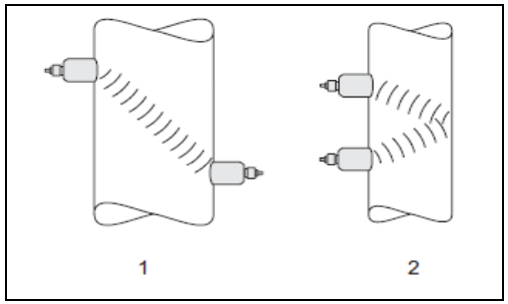
Top view of sensor installation positions:
- Sensor installation position for single-path measurement
- Sensor installation position for dual-path measurement
2. Sensor Installation Method
The number of paths for acoustic signal propagation depends on the sensor type, nominal pipe diameter, and pipe wall thickness. The following installation methods are recommended:
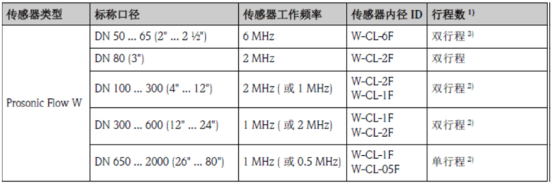
- Clamp-on sensors are recommended to use the dual-path measurement installation position. Dual-path installation is the simplest and most appropriate. Even if operation is only allowed on one side of the pipe, the entire measurement system can still be installed. However, under certain specific conditions, single-path installation is more suitable, for example:
- Some plastic pipes with wall thickness > 4 mm
- Lined pipes
- Measurement of fluids with acoustic damping
- For composite material pipes (such as GRP), some lined pipes, pipes with wall thickness > 10 mm, or when flow measurement of fluids with heavy acoustic damping is required, it is recommended to use sensors with an operating frequency of 0.5 MHz. In this case, the W-type sensor installation position for single-path measurement is recommended.
- Sensors with an operating frequency of 6 MHz are suitable for flow velocity... (The original text is incomplete here; it is recommended to supplement the complete content)