
Overview of TMT31 Temperature Transmitter Modular Installation Wiring
The TMT31 temperature transmitter adopts a modular installation design and is widely used in industrial temperature measurement and signal conversion. Correct wiring is the prerequisite for ensuring measurement accuracy and stable system operation.
Depending on the wiring configuration of the RTD used, the terminal connections of the TMT31 also differ. RTDs commonly have 2-wire, 3-wire, and 4-wire connection methods, which are explained separately below.
TMT31 RTD Wiring Methods
2-Wire RTD Wiring
2-wire RTD wiring is the simplest and is suitable for applications with low accuracy requirements.
- Connect one end of the RTD to the terminal (common terminal)
- Connect the other end of the RTD to terminal 6
3-Wire RTD Wiring
3-wire wiring can effectively compensate for measurement errors caused by lead resistance and is the most commonly used connection method in industrial sites.
- Connect one end of the RTD to terminal 4
- Connect the other end of the RTD to terminal 5 and terminal 6 respectively
4-Wire RTD Wiring
4-wire wiring offers the highest accuracy and is suitable for high-precision temperature measurement applications, completely eliminating the effect of lead resistance.
- Connect one end of the RTD to terminal 3 and terminal 4
- Connect the other end of the RTD to terminal 5 and terminal 6
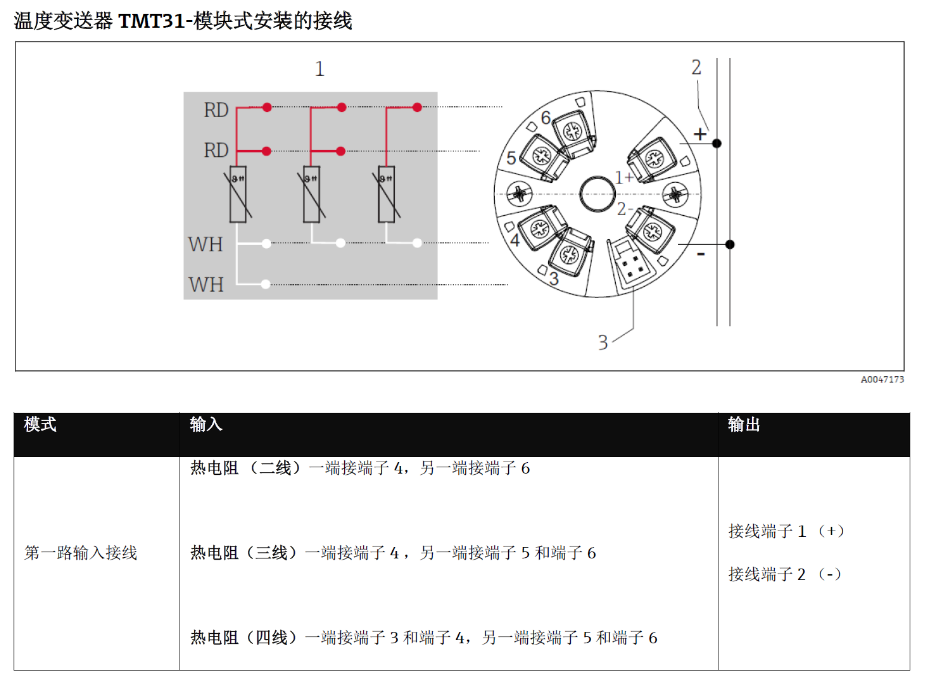
Comparison of Three Wiring Methods
| Wiring Method | Terminal Connection | Accuracy | Application |
|---|---|---|---|
| 2-wire | One end to terminal, the other end to terminal 6 | Relatively low | Applications with low accuracy requirements |
| 3-wire | One end to terminal 4, the other end to terminal 5 and terminal 6 | Relatively high | Commonly used in industrial sites |
| 4-wire | One end to terminal 3 and terminal 4, the other end to terminal 5 and terminal 6 | Highest | High-precision temperature measurement applications |
Wiring Precautions
- Before wiring, please confirm that the RTD wiring configuration matches the transmitter settings.
- Terminal connections should be firm and reliable to avoid measurement fluctuations caused by loose connections.
- It is recommended to use shielded cables and perform proper grounding to suppress interference.
- For 3-wire wiring, the two compensation wires should be as equal in length and of the same material as possible.
Summary
The TMT31 temperature transmitter supports 2-wire, 3-wire, and 4-wire RTD connections. Users can choose the appropriate wiring method according to measurement accuracy requirements and site conditions.
Correct wiring not only improves temperature measurement accuracy but also extends the service life of the transmitter, making it a key link that cannot be ignored in engineering installation.