
T-mass 65 Low Flow Cutoff Overview
T-mass 65 is a thermal mass flowmeter introduced by Endress+Hauser, widely used for gas flow measurement. In actual operating conditions, when the gas flow in the pipeline is below a certain threshold, the flowmeter output may fluctuate due to noise or zero drift. The Low Flow Cutoff function can effectively suppress such interference and ensure the stability of the measurement output.
By setting the low flow cutoff value reasonably, false accumulation or alarms under no-flow or micro-flow conditions can be avoided. Based on the T-mass 65 operating interface, this article introduces the specific configuration steps.
Function and Principle of Low Flow Cutoff
Why Low Flow Cutoff Is Needed
- Suppress noise: At low flow, the sensor signal is weak and susceptible to electromagnetic interference and fluid pulsation, causing output fluctuation.
- Avoid false accumulation: When the actual flow is zero, small signals may be accumulated, causing measurement deviation.
- Improve system stability: After cutoff, the output is forced to zero, making it easier for the downstream control system to determine the actual operating condition.
Working Principle
When the measured flow is below the set threshold, the flowmeter forces the output signal to zero (or low level) and stops accumulation. This threshold is usually expressed as a percentage or in engineering units, depending on the instrument configuration.
T-mass 65 Low Flow Cutoff Configuration Steps
The following steps apply to local operation of the T-mass 65 or remote configuration via FieldCare/DeviceCare software. Please ensure that you have entered the Expert or Maintenance menu.
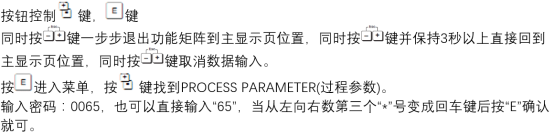
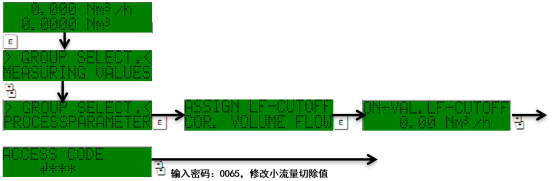
- Enter the setup menu: On the main screen, press the E key to enter the menu, and select "Setup" → "Advanced Setup" → "Process Parameter" → "Low Flow Cutoff".
- Select the cutoff mode: Options include "Off" and "On". Usually select "On" to enable the cutoff function.
- Set the cutoff value: Enter the required low flow cutoff value, with the unit consistent with the flowmeter configuration (e.g., kg/h, Nm³/h). It is recommended to set it to 1%~3% of the full scale, depending on the actual operating conditions.
- Set hysteresis: To prevent frequent switching near the threshold, a hysteresis value can be set, usually 10%~20% of the cutoff value.
- Save and exit: Press the E key to confirm and return to the main screen. Observe the flow display to verify whether the cutoff function is effective.
Parameter Descriptions and Recommended Values
| Parameter | Description | Recommended Value |
|---|---|---|
| Low Flow Cutoff | Enable or disable low flow cutoff | On |
| Cutoff Value | Cutoff threshold; output is zero below this value | 1%~3% of full scale |
| Hysteresis | Hysteresis value to avoid frequent switching | 10%~20% of cutoff value |
| Unit | Flow unit | Consistent with main display |
Precautions and Common Issues
Precautions
- Before setting, confirm the full scale value and flow unit to avoid incorrect cutoff values caused by unit confusion.
- The cutoff value should not be too large, otherwise real low flow signals will be lost; it should also not be too small, otherwise it will not provide suppression.
- If the process allows brief reverse flow, confirm whether the cutoff affects reverse measurement.
- After modifying parameters, it is recommended to perform a zero calibration to ensure stable output when there is no flow.
Common Issues
- Flow display still fluctuates after cutoff: Check whether the cutoff value is too small, or whether the sensor is affected by vibration interference.
- Totalizer does not increase: Confirm whether the actual flow is below the cutoff threshold, or whether the cutoff value is set too high.
- Unable to enter the menu: Check whether the correct password has been entered, or whether the instrument is in a locked state.
Correctly setting the low flow cutoff of the T-mass 65 can significantly improve measurement reliability under low flow conditions. For further optimization, commissioning can be carried out in combination with on-site process parameters.