
FMU30 Ultrasonic Level Transmitter Basic Setup Overview
FMU30 is an ultrasonic level transmitter under Endress+Hauser, widely used for level measurement in water treatment, chemical, food, and other industries. Correct basic setup is the prerequisite for ensuring measurement accuracy. This guide is based on the FMU30/FMU4x concise operating manual and outlines the key setup steps and precautions.
Preparation Before Setup
Installation Check
- Confirm that the instrument is correctly installed, with the probe perpendicular to the liquid surface, and avoid installation near the inlet or agitator.
- Check whether the supply voltage meets the nameplate requirements (usually 24 V DC or 220 V AC).
- Ensure there is no strong electromagnetic interference on site; use shielded cables for signal lines and ground them at one end.
Tools and Materials
- Operating manual (FMU30/FMU4x concise operating guide).
- Handheld terminal or commissioning software (such as FieldCare).
- Tape measure or a reference object with a known level.
Basic Setup Steps
The following steps are applicable for initial commissioning of the FMU30 or quick setup after parameter reset.
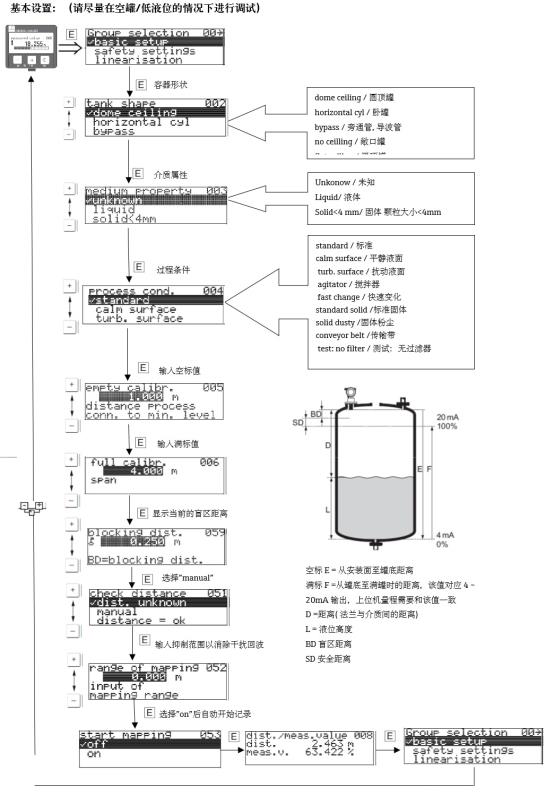
- Power-on and self-test: Connect the power supply. The instrument performs a self-test. After the display lights up, it enters the measurement interface.
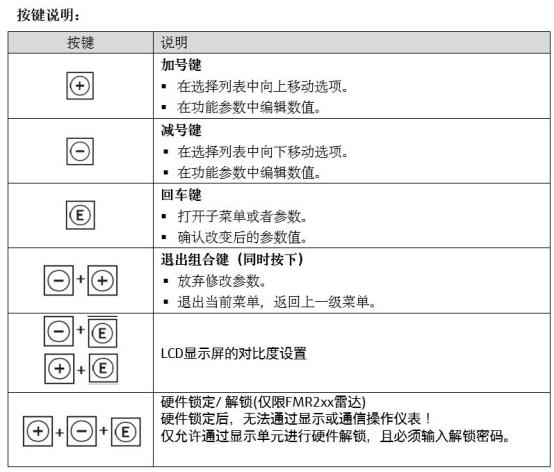
- Enter the menu: Press the E key to enter the main menu, and use the + / - keys to select the "Basic Setup" option.
- Set empty tank height (E point): Enter the distance from the bottom face of the probe to the tank bottom (i.e., the zero point of the level when the tank is empty).
- Set full tank height (F point): Enter the distance from the bottom face of the probe to the highest liquid level to ensure the measuring range covers the actual level range.
- Set medium properties: Select "liquid" or "solid" according to the measured medium, and set the dielectric constant range (optional).
- Set output current: Select the level range corresponding to the 4-20 mA output, usually consistent with the empty tank/full tank height.
- Save and exit: Press the E key to confirm and save, then return to the measurement interface.
Description of Key Parameters
| Parameter | Description | Typical Value |
|---|---|---|
| Empty tank height (E) | Distance from probe to tank bottom | 0.3~5 m |
| Full tank height (F) | Distance from probe to highest liquid level | 0.2~4.5 m |
| Medium type | Liquid or solid | Liquid |
| Output range | Level corresponding to 4-20 mA | 0~100% |
| Response time | Time for the instrument output to follow level changes | ≥ 3 s |
Precautions and Common Problems
Precautions
- When setting the empty tank/full tank height, be sure to use actual measured values to avoid errors caused by estimation.
- If there is agitation or foam in the tank, it is recommended to enable the echo suppression function or adjust the installation position.
- In hazardous areas, use intrinsically safe instruments and comply with relevant safety regulations.
Common Problems
- Large fluctuation in measured value: Check whether the probe has condensation or interfering echoes. Try increasing the response time.
- No current output: Confirm that the power supply is normal, check the wiring polarity, and restore factory settings if necessary.
- "E" error displayed: This usually indicates echo loss. Check whether the empty tank height setting is correct, or whether the medium surface fluctuates violently.
Summary
The basic setup of the FMU30 is a key step to ensure accurate level measurement. By correctly setting the empty tank height, full tank height, and output range, and paying attention to installation and medium characteristics, the stability of the instrument can be significantly improved. It is recommended to record the parameters after commissioning for subsequent maintenance and troubleshooting.