What Is a Flowmeter?
A flowmeter is an instrument or device used to measure the volumetric flow rate or mass flow rate of a fluid (liquid, gas, or steam) flowing in a pipe or channel. Its core function is to monitor the fluid flow rate in real time or cumulatively, and it is widely used in industrial production, energy metering, environmental protection, medical equipment, and other fields.
Before Flowmeter Selection: Clarify 6 Core Requirements
Before choosing a flowmeter, you need to clarify your core requirements. It is recommended to review them one by one from the following six dimensions.
1. What fluid is being measured?
- Type: Liquid, gas, steam, or multiphase mixed fluid (such as slurry containing solid particles)?
- Physical properties: Viscosity (low viscosity such as water, high viscosity such as heavy oil), corrosiveness (such as strong acid/alkali), conductivity (electromagnetic flowmeters require conductive liquids), whether it contains impurities or bubbles?
- Temperature/pressure: High temperature (such as steam), high pressure (such as industrial pipelines), or low temperature (such as liquefied gas)?
2. What parameters need to be measured?
- Flow type: Volumetric flow rate (m³/h, L/min) or mass flow rate (kg/h)?
- Monitoring method: Instantaneous flow rate (real-time monitoring) or cumulative flow rate (total metering)?
- Accuracy requirements: Is high accuracy required (such as trade settlement within ±0.5%), or is process monitoring sufficient (±2%~5%)?
3. What are the piping conditions?
- Pipe diameter: Small diameter (DN15~DN50, such as laboratory), medium diameter (DN50~DN200, common industrial pipelines), or large diameter (above DN200, such as water treatment)?
- Installation space: Is there enough straight pipe section (for example, vortex flowmeters require 10D upstream and 5D downstream straight pipe sections)? Is pipe cutting allowed for installation (such as insertion type vs. non-contact type)?
4. Special characteristics of the application scenario
- Trade settlement (such as natural gas billing): Choose a type with high accuracy, strong stability, and metrological certification (such as Coriolis flowmeter, turbine flowmeter).
- Flammable and explosive environments (such as petrochemicals): Use explosion-proof flowmeters (such as explosion-proof electromagnetic flowmeters).
- Sanitary requirements (such as food and pharmaceuticals): Choose types that are easy to clean and have no dead angles (such as sanitary electromagnetic flowmeters, positive displacement flowmeters).
5. Budget and long-term cost
- Initial cost: Ultrasonic flowmeters and rotameters have lower cost; Coriolis flowmeters and electromagnetic flowmeters have higher cost.
- Operating cost: Differential pressure flowmeters (such as orifice plates) have large pressure loss and may increase energy consumption; ultrasonic and electromagnetic flowmeters have low pressure loss.
- Maintenance cost: Positive displacement flowmeters (gear/roots) require regular cleaning of gears; vortex flowmeters are sensitive to fluid impurities and may require pre-filters.
6. Other functional requirements
- Is remote data transmission required (such as 4~20mA signal, RS485 communication)?
- Is temperature/pressure compensation required (for example, gas flow is greatly affected by temperature and requires temperature and pressure sensors)?
Selecting Flowmeters by Fluid Type
1. Liquid measurement
| Fluid characteristics | Recommended flowmeter | Reason | Avoid |
|---|---|---|---|
| Clean water, low-viscosity liquids | Electromagnetic flowmeter, turbine flowmeter | Electromagnetic flowmeter has high accuracy and low pressure loss; turbine flowmeter has low cost and fast response | Rotameter (low accuracy) |
| High-viscosity liquids (such as heavy oil) | Positive displacement flowmeter (oval gear, roots) | Directly measures volume, little affected by viscosity, high accuracy | Vortex flowmeter (large error at low flow rates) |
| Corrosive liquids (such as acid/alkali) | Electromagnetic flowmeter (corrosion-resistant lining), ultrasonic flowmeter | Lining material (such as PTFE) is corrosion-resistant; ultrasonic is non-contact measurement | Metal positive displacement flowmeter |
| Slurry containing solid particles | Electromagnetic flowmeter, ultrasonic flowmeter | Electromagnetic flowmeter has no moving parts and is not easy to clog; ultrasonic is non-contact and suitable for dirty fluids | Turbine flowmeter (easy to wear) |
| Non-conductive liquids (such as oils) | Vortex flowmeter, Coriolis mass flowmeter | Vortex flowmeter is suitable for medium and high flow rates; Coriolis flowmeter directly measures mass flow and requires no temperature compensation | Electromagnetic flowmeter (requires conductivity) |
2. Gas measurement
| Fluid characteristics | Recommended flowmeter | Reason | Avoid |
|---|---|---|---|
| Clean gases such as air and natural gas | Vortex flowmeter, thermal mass flowmeter | Vortex flowmeter has low cost; thermal flowmeter directly measures mass flow and requires no temperature and pressure compensation | Positive displacement flowmeter (gas viscosity is low, large error) |
| High-temperature steam | Vortex flowmeter, orifice flowmeter | Vortex flowmeter has good temperature resistance; orifice plate with differential pressure transmitter has low cost | Turbine flowmeter (steam may carry liquid, wears impeller) |
| Low-flow-rate gas | Ultrasonic flowmeter, rotameter | Ultrasonic is suitable for large-diameter low-flow-rate; rotameter is simple and intuitive | Vortex flowmeter (large error at low Reynolds number) |
| Flammable and explosive gases | Explosion-proof vortex flowmeter, Coriolis flowmeter | Explosion-proof certification required; Coriolis flowmeter has high safety | Non-explosion-proof electromagnetic flowmeter |
3. Special fluids (multiphase flow, mixed fluids)
- Gas-liquid two-phase flow: Coriolis mass flowmeter (directly measures mass, unaffected by phase state), ultrasonic flowmeter (requires special algorithms to handle bubbles).
- Slurry/fiber-containing fluids: Electromagnetic flowmeter (no clogging risk), insertion vortex flowmeter (probe requires regular cleaning).
Comparison of Key Indicators by Measurement Principle
| Type | Accuracy | Pressure loss | Applicable flow velocity range | Cost | Maintenance difficulty | Typical scenario |
|---|---|---|---|---|---|---|
| Electromagnetic flowmeter | ±0.5%~±1% | Low | 0.1~15 m/s | Medium-high | Low (no moving parts) | Conductive liquids (water, sewage) |
| Vortex flowmeter | ±1%~±1.5% | Medium | 2~70 m/s (gas) | Medium | Medium (needs impurity protection) | Steam, gas, liquid |
| Turbine flowmeter | ±0.5%~±1% | Medium | 0.5~10 m/s | Medium | Medium (requires regular lubrication) | Clean liquids (petroleum, chemicals) |
| Positive displacement flowmeter | ±0.1%~±0.5% | High | 0.1~5 m/s | High | High (parts need disassembly and cleaning) | High-viscosity liquids (heavy oil, lubricating oil) |
| Coriolis flowmeter | ±0.1%~±0.5% | High | 0.05~25 m/s | Very high | Low (no moving parts) | High-precision mass measurement (food, pharmaceuticals) |
| Ultrasonic flowmeter | ±1%~±2% | Low | 0.01~20 m/s | Low | Low (non-contact) | Large-diameter pipelines, corrosive fluids |
| Rotameter | ±2%~±5% | High | 0.05~10 m/s | Low | Low (simple structure) | Laboratory small-flow monitoring |
Selection Steps: A 5-Step Process from Requirements to Implementation
- Use elimination to narrow the range: Based on fluid conductivity, eliminate the applicability of electromagnetic flowmeters (not usable for non-conductive liquids); based on whether impurities are present, eliminate turbine/positive displacement flowmeters (more impurities cause easy wear).
- Prioritize core indicators: For high-accuracy requirements (such as trade settlement), prioritize Coriolis flowmeter > turbine flowmeter > electromagnetic flowmeter; for low-maintenance requirements (such as difficulty in frequent shutdowns), prioritize electromagnetic flowmeter (no moving parts) > ultrasonic flowmeter (non-contact).
- Verify installation conditions: When straight pipe sections are insufficient, abandon vortex/orifice flowmeters and choose ultrasonic (clamp-on) or insertion electromagnetic flowmeters; when pipeline vibration is large, avoid turbine flowmeters (impeller is susceptible to vibration interference) and choose Coriolis or electromagnetic flowmeters.
- Balance cost and lifespan: For long-term operation scenarios, prioritize types with low pressure loss and low energy consumption (such as electromagnetic flowmeters are more energy-efficient than orifice plates); for short-term temporary measurement, choose low-cost ultrasonic flowmeters (no need for tapping installation).
- Refer to industry cases: The water supply industry mainly chooses electromagnetic flowmeters or ultrasonic flowmeters (ultrasonic for DN200 and above); petrochemicals commonly use a combination of Coriolis flowmeter (mass metering) + turbine flowmeter (volumetric metering); food and pharmaceuticals mostly choose sanitary electromagnetic flowmeters or positive displacement flowmeters (such as piston type).
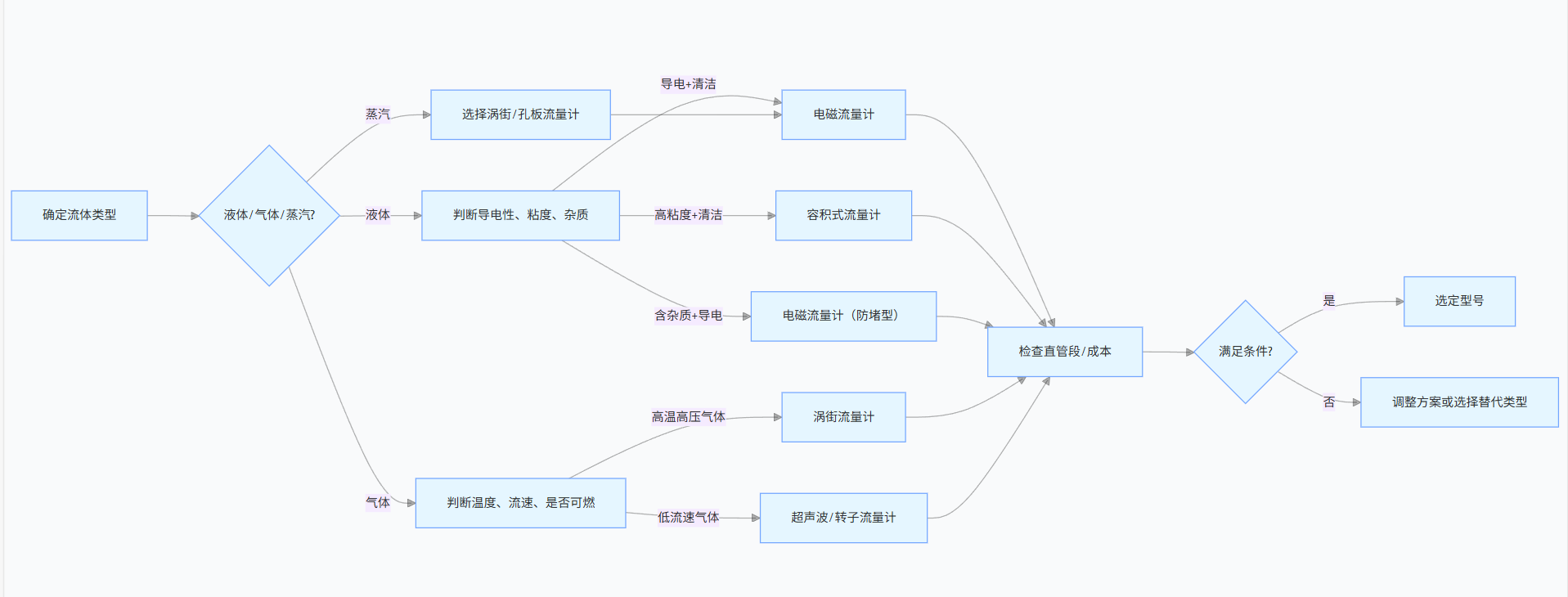
Summary: Selection Decision Tree
Based on the above fluid characteristics, parameter requirements, piping conditions, budget, and industry cases, the suitable flowmeter type can be quickly identified. The following decision tree is provided for intuitive reference.