
This article mainly introduces E+H instrument explosion-proof selection. The core function of instrument explosion-proofing is to prevent the instrument from becoming an ignition source in flammable and explosive environments, thereby avoiding explosions or fires and ensuring the safety of personnel, equipment, and the production environment. The following introduces the key points of explosion-proof selection from multiple aspects.
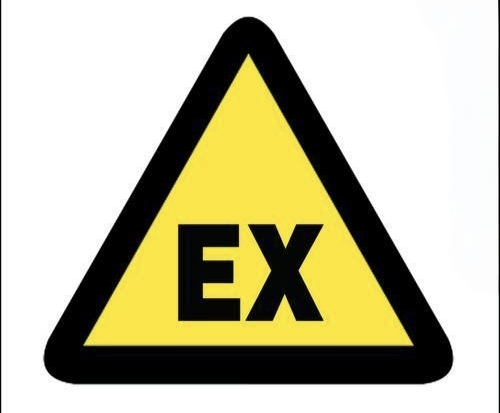
I. Basic Concepts of Explosion Protection and Standard Selection
When selecting explosion-proof instruments, they must first comply with the standards of the region or location where they are used. Equipment design, installation, and component requirements differ across regions, so selection must be based on the region and standards.
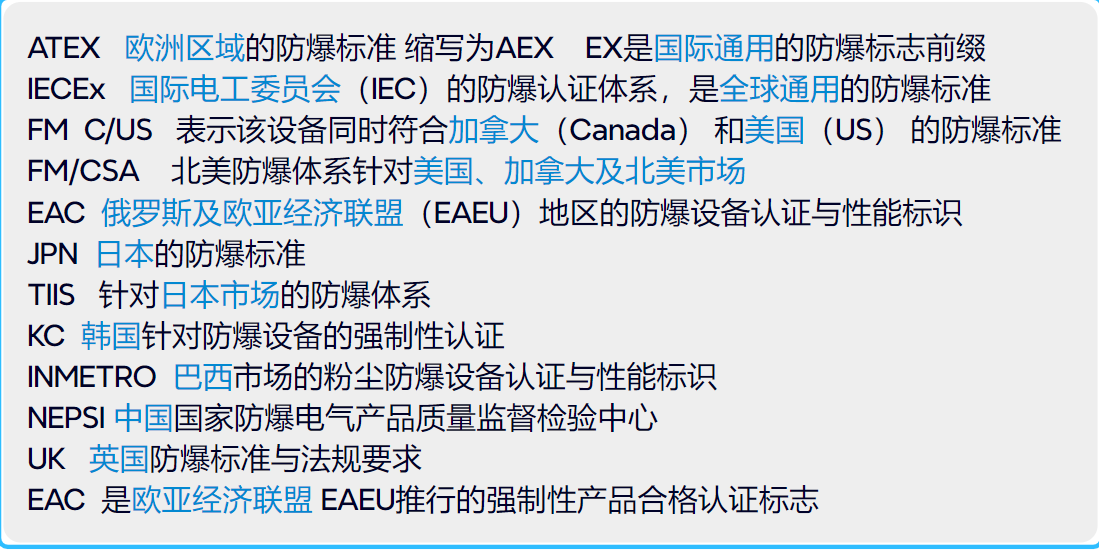
The above figure includes most countries and regions and the standard abbreviations they use. Common explosion-proof standard systems include:
- IECEx: International Electrotechnical Commission Explosive Atmospheres Certification System
- ATEX: EU Explosion Protection Directive
- NEPSI: China Explosion-Proof Certification
- FM/UL: North American Explosion-Proof Certification
During procurement, it is necessary to clarify the region where the equipment will be used and select products with the corresponding certification to avoid safety hazards or compliance issues caused by non-compliant standards.
II. Gas Explosion-Proof Markings and Core Parameters
Gas explosion-proof markings can be selected based on the equipment category and the applicable gas environment. Equipment categories are divided into I, II, and III:
- Category I: Equipment for underground coal mines
- Category II: Explosion-proof equipment for non-coal mines
- Category III: Equipment for dust environments
The gas environment is generally selected based on the explosive gas atmosphere "zone level + Group G medium". The corresponding relationship of zone levels is as follows:
| Zone Level | Definition | Applicable Equipment Level |
|---|---|---|
| Zone 0 | Explosive gas mixture present continuously/long-term | 1G |
| Zone 1 | Explosive gas mixture likely to occur occasionally | 2G |
| Zone 0 + Zone 1 | Meets the requirements of both Zone 0 and Zone 1 | 1G+2G |
Core Marking Format
The core gas explosion-proof marking format is: Ex [protection type] [gas group] [temperature group] [EPL]. The meanings of each parameter are as follows:
Protection Type
- Ex d: Flameproof enclosure type (corresponds to North American XP)
- Ex e: Increased safety type
- Ex ia: Intrinsically safe type (ia level), the highest protection level for gas explosion protection, can be used in Zone 0
- Ex ib: Intrinsically safe type (ib level), with lower fault count requirements than ia level
- Ex m: Encapsulation type
- Ex p: Pressurized enclosure type
- Ex o: Oil immersion type
- Ex q: Sand filling type
- LS: North American intrinsically safe type
Gas Group
Gas groups are classified by "minimum ignition energy" (A < B < C). Group IIC contains the most dangerous gases (such as hydrogen and acetylene) and covers the applicable range of IIA (propane) and IIB (ethylene).
In North American standards, Class I applies to explosive gas/vapor environments (such as methane and propane). Group A/B/C/D respectively correspond to:
- Group A: Acetylene
- Group B: Hydrogen
- Group C: Ethylene
- Group D: Methane, propane
Temperature Group
Temperature groups are classified by "maximum surface temperature" (T1 to T6, with temperature decreasing in order). T4 can be used in gas environments with an ignition temperature of 135°C or higher.
| Temperature Group | Maximum Surface Temperature |
|---|---|
| T4 | ≤135°C |
| T5 | ≤100°C |
| T6 | ≤85°C |
Equipment Protection Level (EPL)
- Ga: Highest protection level for Zone 0 ("high" protection)
- Gb: Protection level for Zone 1 ("high" protection)
- Ga/Gb: Equipment can simultaneously meet the protection requirements of Zone 0 and Zone 1
III. Dust Explosion-Proof Markings and Core Parameters
The equipment types for dust explosion protection are the same as those for gas explosion protection. Dust environments are classified according to the explosive dust atmosphere "zone level" + "Group D medium":
| Zone Level | Definition | Applicable Equipment Level |
|---|---|---|
| Zone 20 | Explosive dust cloud present continuously/long-term | 1D |
| Zone 21 | Explosive dust cloud likely to occur occasionally | 2D |
The core marking format is the same as for gas explosion protection.
Protection Type
- Ex ta: Dust explosion-proof enclosure type (ta level), the highest protection level for dust explosion protection, can be used in Zone 20
- Ex tb: Dust enclosure protection type
- Ex tc: Dust enclosure protection type (tc level)
- Ex td: Dust restricted breathing type
Dust Group
Dust groups are classified by "ignition characteristics":
- IIIC: Conductive dust (such as graphite powder and metal powder)
- IIIB: Non-conductive combustible dust (such as flour and coal powder)
- IIIA: Combustible flyings (such as cotton lint and synthetic fiber lint)
In North American standards, Class II applies to explosive dust environments (such as flour and coal powder), and Class III applies to explosive fiber/flyings environments (such as cotton lint and synthetic fiber lint). Group E/F/G respectively correspond to:
- Group E: Metal dust (such as aluminum powder)
- Group F: Carbon dust (such as coal dust)
- Group G: Grain dust (such as flour)
Equipment Protection Level (EPL)
- Db: "High" protection level for Zone 20
- Div.1: North American hazardous area "division level", indicating that explosive substances may frequently be present during normal operation (corresponding to international standard Zone 0/1/20/21)
IV. Selection Summary
When selecting E+H instruments, the corresponding selection can be made according to the above content. This article covers most explosion-proof selection content as well as introductions to alternative names in different regions. Correct selection requires comprehensive consideration of the applicable regional standards, equipment category, zone level, protection type, gas/dust group, temperature group, and EPL level to ensure the safe and reliable operation of the instrument in a specific hazardous environment.
At this point, the introduction to E+H instrument explosion-proof selection is complete.