
E+H Instrument Selection: Comprehensive Analysis of Electrical Connections and External Parameters
In the field of industrial automation, the selection of E+H instruments is a systematic task involving multiple technical aspects. Among them, electrical connections and external parameters are key parts to ensure stable operation of the instrument and its integration into the control system. This article will introduce in detail the classification, specifications, and applicable scenarios of these parameters to help engineering technical personnel and procurement personnel make precise choices.
1. Electrical Connections
Electrical connection refers to the process of establishing a stable electrical path between the instrument and external electrical systems (such as power supply, central control equipment, sensors, etc.) through cables, connectors, terminals, and other components. Its core function is to achieve power transmission and signal interaction, and it is the foundation for the normal operation of the instrument.
1.1 Thread Specifications
Thread specifications determine the sealing method of the cable entry and the applicable scenarios. Common types include:
- M20 cable gland: Metric thread, outer diameter 20 mm, pitch 1.5 mm. Used for fixing cables, sealing protection, and insulation isolation.
- G1/2 thread: British standard non-sealing cylindrical pipe thread, thread angle 55°, nominal diameter 1/2 inch. Requires a sealing ring to achieve sealing, suitable for occasions with low sealing requirements.
- NPT1/2 thread: American standard 60° tapered pipe thread, nominal diameter 1/2 inch. Sealed through metal-to-metal contact, requires applying sealant or wrapping PTFE tape, suitable for high-pressure, high-temperature, or high-sealing requirement occasions.
1.2 Plug Connector Types
Plug connectors are used for quickly connecting electrical equipment. Common types include:
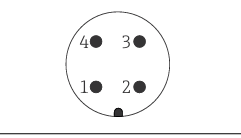
- M12 plug connector: Metric circular connector, outer diameter 12 mm, small size and reliable connection, commonly used for sensor and actuator connections.
- 7/8" plug connector: Size 7/8 inch, suitable for electrical connections between industrial equipment.
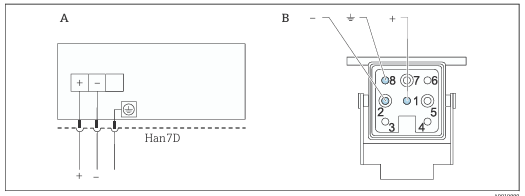
- HAN7D plug connector (90 degrees): Model HAN7D, 90-degree angle design, saves space, avoids excessive bending of cables damaging conductors.
1.3 Materials and Protection Ratings
The material of electrical connection components affects durability and environmental adaptability:
- Plastic: Lightweight, insulating, suitable for general environments.
- Nickel-plated brass: Brass has good mechanical properties, and after nickel plating, corrosion resistance is stronger and appearance is better.
Protection rating standards include:
| Standard | Meaning |
|---|---|
| IP66 | Completely dust-tight, protected against strong water jets |
| IP68 | Completely dust-tight, capable of prolonged immersion in water |
| NEMA 4X | Suitable for indoor and outdoor use, dust-tight, water splash, hose spray, and corrosion resistant |
| NEMA 6P | Suitable for indoor and outdoor use, dust-tight, capable of prolonged water immersion |
2. External Parameters
External parameters involve the instrument's materials, certifications, additional functions, etc., directly affecting applicability and compliance.
2.1 Lining Materials
Linings are divided by material into hard rubber and polyurethane:
- Hard rubber: Suitable for room-temperature drinking water, partially resistant to hot water. Certifications include ACS (France), NSF (USA), KTW/W270 (Germany), hot water certification (≤90°C). Imported materials have no certification; prohibited selection indicates unavailable. HRS is the hard rubber model.
- Polyurethane: Suitable for room temperature and hot water, with better elasticity and temperature resistance. Certifications include WRAS (UK), BS9620. Without certification, it cannot be used in drinking water systems.
2.2 Additional Tests and Certificates
To ensure compliance and safety, the following certificates may be required:
- Material certificate (pipe + flange): Third-party proof that the material complies with standards such as EN and ANSI.
- PED Cat. II/III: EU Pressure Equipment Directive classification; medium- and high-risk equipment must comply.
- CRN Canada certification: Mandatory registration for pressure-bearing equipment in Canada.
- Pressure test: Pressure test report to verify no leakage and no deformation.
2.3 Additional Contacts
Additional contacts expand device functions:
- 1x 4...20mA input: Receives external analog signals.
- 2x/4x relays: Realizes automatic control such as limit, PID control, timing, and chemical cleaning.
2.4 Additional Options
Additional options are divided into three categories:
- Compliance certification category: Such as EN10204 3.1 certificate, NACE MR0175 sulfide stress corrosion resistance, classification society certification (GL/ABS), test report, factory pressure test certificate.
- Function expansion category: Such as SIL safety level, software adjustment, overvoltage protection, HistoROM data storage, M-DAT parameter storage.
- Installation accessory category: Such as mounting bracket (wall-mounted/pipe-mounted, 316L or 304 heavy-duty type), valve manifold installation (front/rear).
3. O-rings and Filling Fluids
3.1 O-ring Materials
O-rings are divided by material into five categories:
- Fluororubber (FKM Viton): Oil-resistant, temperature-resistant, chemical corrosion-resistant. Available in general-purpose, grease-prohibited, and oxygen service types.
- Polytetrafluoroethylene (PTFE): Resistant to strong corrosion and high temperature, resistant to almost all chemical media. Available in PN160bar and PN250bar versions, as well as oxygen service type.
- Nitrile rubber (NBR): Low-cost oil resistance, temperature resistance -40°C to 120°C, not resistant to strong acids and bases.
- Ethylene propylene diene monomer (EPDM): Water-resistant, steam-resistant, acid and alkali resistant, but not oil resistant.
- Metal seal (copper sealing ring): Resistant to high pressure and high temperature, can reach above 400°C. Available in oxygen service type.
3.2 Filling Fluid Types
Filling fluid affects the instrument's temperature adaptability and chemical compatibility:
- Silicone oil: General-purpose, chemically stable, wide temperature resistance, good insulation.
- Silicone oil, FDA high-temperature oil: Food/pharmaceutical grade, high-temperature resistant, low volatility. Vegetable oil, FDA certified, harmless to human body.
- Inert oil (PFPE): For extreme chemical environments, reacts with almost no substances.
- Silicone oil, diaphragm seal: Used for diaphragm seal systems.
- Low-temperature oil: Low pour point, maintains fluidity and performance at low temperatures.
In summary, E+H instrument selection requires comprehensive consideration of electrical connections, external parameters, O-rings, and filling fluids. Users can refer to this article to choose the appropriate configuration according to specific working conditions and certification requirements.