
8E3B Mass Flowmeter Overview
8E3B is a mass flowmeter launched by the German company E+H, consisting of a transmitter and a sensor. Before introducing the specific usage steps, understanding its measurement principle will help with proper installation and commissioning.
Coriolis Force Measurement Principle
Coriolis Force and Mass Flow
The measurement system operates based on the Coriolis force measurement principle. The Coriolis force refers to the force experienced by an object moving in a straight line within a rotating system, and its magnitude depends on the mass Δm and radial velocity v of the moving object, i.e., mass flow.
The sensor uses the vibration of the measuring tubes to replace the constant angular velocity ω of a rotating system. When fluid flows through the sensor, two parallel measuring tubes inside vibrate in opposite phases, similar to the action of a tuning fork.
Relationship Between Phase Difference and Flow
The measuring tubes deform under the action of the Coriolis force, resulting in a phase difference at both ends:
- When the flow is 0 (fluid stationary), the two measuring tubes vibrate in phase with no phase difference (position 1);
- When there is mass flow, the vibration accelerates at the inlet (position 2) and decelerates at the outlet (position 3), creating a phase difference (2)—(3).
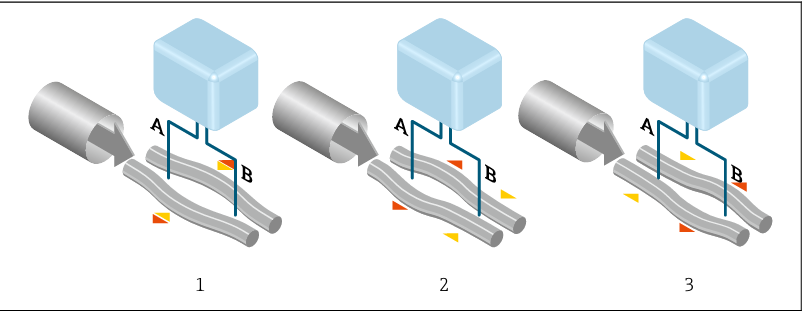
The greater the mass flow, the greater the phase difference (A-B). Electromagnetic phase sensors record the vibration phases at the inlet and outlet of the measuring tubes, and the two measuring tubes vibrate in opposite phases to achieve system balance.
This measurement principle is completely unaffected by temperature, pressure, viscosity, conductivity, and fluid properties.
Density, Volume, and Temperature Measurement
The measuring tubes vibrate continuously at their resonant frequency. A change in mass causes a change in the density of the vibrating system (measuring tubes + fluid), which automatically changes the system vibration frequency. The resonant frequency is a function of the medium density. The microprocessor calculates the density signal based on this relationship.
- Volume flow: calculated based on the mass flow measurement value;
- Temperature compensation: monitors the measuring tube temperature to calculate the temperature effect compensation coefficient;
- Temperature output: the measuring tube temperature is the same as the process temperature and can be used as an output signal.
Therefore, this instrument can simultaneously measure mass flow, volume flow, density, and temperature.
8E3B Wiring Steps
After introducing the principle, let's begin with the usage steps. First is wiring. Connect the 24V power supply line to the positive and negative terminals as indicated.
| Terminal | Function |
|---|---|
| 1 | Positive (24V+) |
| 4 | Negative (24V-) |
| 2, 3 | Can be connected to other modules |
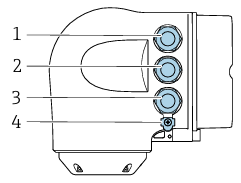
After turning on the power, testing can begin.
Operation Interface and Button Description
Touch Display and Unlocking
After power-on, the operation interface is visible, consisting of a display and buttons. There are no physical buttons; it uses a touch display that can be operated by hand. After startup, it enters a locked state. Press and hold the E key and the minus key simultaneously for 3 seconds to unlock the keypad.
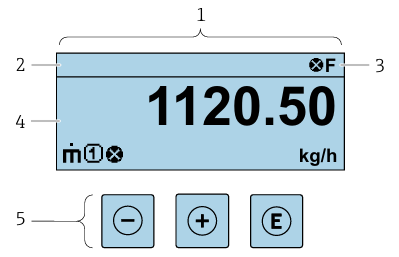
Button Functions
- Minus key: move left one position;
- Plus key: move right one position;
- E key: Enter key, press quickly to confirm selection; press and hold for 2 seconds to confirm input;
- Press plus and minus simultaneously: close the editing view without saving changes.
Press the E key to enter the menu, and use the plus and minus keys to scroll up and down. The next section will introduce how to operate the 8E3B.