
First, let's introduce the advantages and applicable scenarios of this instrument. The new generation Cerabar pressure transmitter is robust and durable, with advanced functions, supports on-site or remote operation, on-demand maintenance, and intelligent and safe process. The firmware design ensures easy operation of the instrument. The operation wizard is intuitive and clear. It uses Bluetooth communication protocol to safely realize remote instrument operation. Large screen display clearly shows measured values. It can withstand pressures up to 400 bar (6000 psi), and with a diaphragm seal, the maximum process temperature can reach 400 °C (752 °F). The accuracy is also very high, ±0.055% of the measuring range.
Below is a schematic diagram of the measurement principle of this pressure transmitter, as shown. The one with a diaphragm seal has an additional metal diaphragm compared to the one without. The principle is that pressure causes deformation of the sensor's metal diaphragm. The fill fluid transmits the pressure to the side of the measuring component where the resistance bridge is located. The bridge output voltage change related to pressure is measured and subsequently calculated and processed.
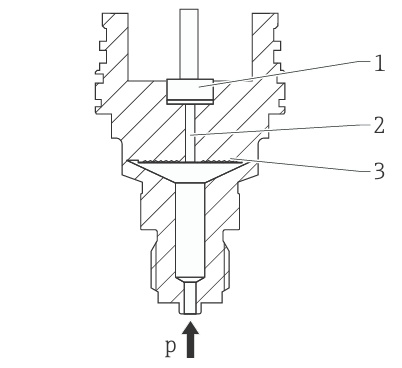
For the one with a diaphragm seal, the pressure acts on the diaphragm of the diaphragm seal system, and the fill fluid transmits the pressure to the internal diaphragm. This causes deformation of the internal diaphragm. The fill fluid transmits the pressure to the measuring component equipped with a resistance bridge. The bridge output voltage change related to pressure is measured and subsequently calculated and processed. In simple terms, pressure acts on the diaphragm, causing deformation, which is then converted into a pressure signal and displayed through the display unit.
Generally, a diaphragm seal is not required; it is only needed in some complex or high-demand situations.
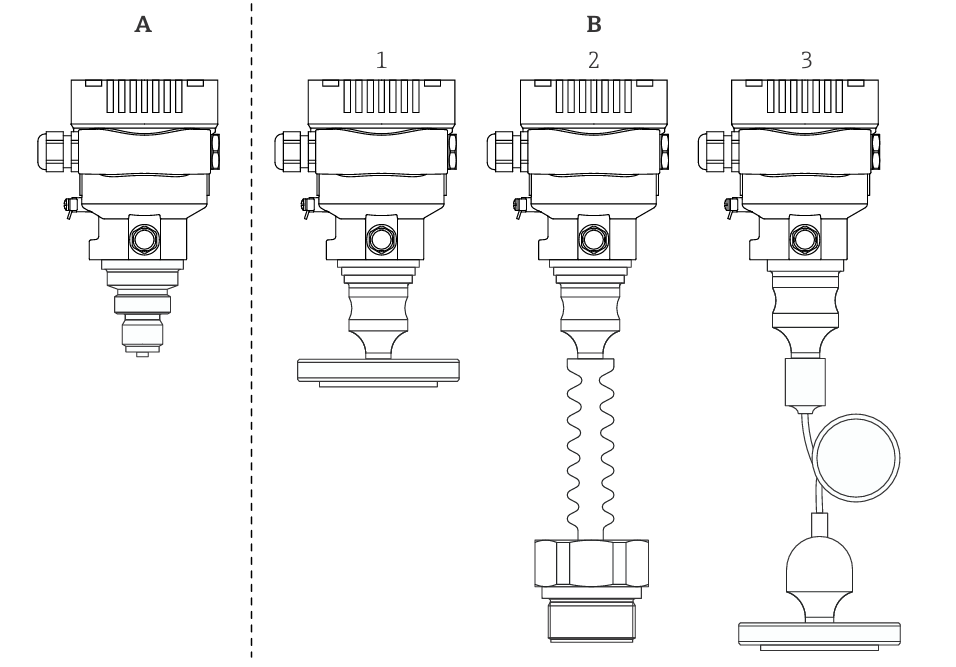
These are some measurement systems of the PMP51B. The corresponding alphanumeric codes are: A standard instrument (without diaphragm seal system), B instrument with diaphragm seal system, 1 instrument with compact diaphragm seal system, 2 instrument with heat insulation tube diaphragm seal system, 3 instrument with capillary diaphragm seal system. When selecting, you can choose according to your needs.
During installation, it should be installed according to pressure gauge installation standards. When adhesion or blockage is likely to occur at the diaphragm, flange flushing rings and flange sealing rings and flat sealing ring flushing rings should be used. During instrument installation and wiring operations, as well as during use, prevent moisture from entering the housing. As much as possible, point cables and plugs downward to prevent moisture from entering.
The diaphragm seal system and the pressure transmitter together form a closed calibrated system. The fill fluid is filled through the filling port in the diaphragm seal system and the transmitter measurement system. The filling port has been sealed; do not open it.
When measuring gas pressure, equipment with a shut-off valve should be installed above the pressure tap to ensure that condensate can flow back into the process. When measuring steam pressure, pay attention to the maximum allowable ambient temperature of the transmitter!
When measuring liquid pressure, instruments with a shut-off valve should be installed below the pressure tap, or at the same height as the pressure tap. For level measurement, always install at the lowest position of the measurement point. These are the basic installation situations.