
Promass 300/500 Empty Pipe Detection Function Overview
Promass 300 and Promass 500 are high-performance Coriolis mass flowmeters launched by Endress+Hauser, widely used in chemical, food, pharmaceutical, and other industries. Empty Pipe Detection (EPD) is one of their important diagnostic functions, capable of real-time monitoring of whether the measuring tube is empty or not completely filled.
Empty pipe detection can effectively avoid false flow readings caused by an empty pipeline and improve process safety. For conditions involving easy vaporization, intermittent transportation, or easy emptying, enabling this function is particularly critical.
Working Principle of Empty Pipe Detection
Promass 300/500 determines whether the pipeline is empty by measuring changes in the vibration characteristics of the measuring tube. When the measuring tube is filled with liquid, the vibration frequency and damping remain stable; when the pipeline is empty, the vibration characteristics change significantly.
Detection Mechanism
- Vibration frequency monitoring: When the pipe is empty, the mass of the measuring tube decreases, and the resonance frequency increases.
- Damping change analysis: When the pipe is empty, damping decreases, and the amplitude increases.
- Signal amplitude comparison: Judgment is made by the ratio of drive current to sensor signal.
The instrument's internal algorithm combines the above parameters to output an empty pipe alarm or fault signal. Users can set the sensitivity threshold according to process requirements.
Steps to Enable Empty Pipe Detection
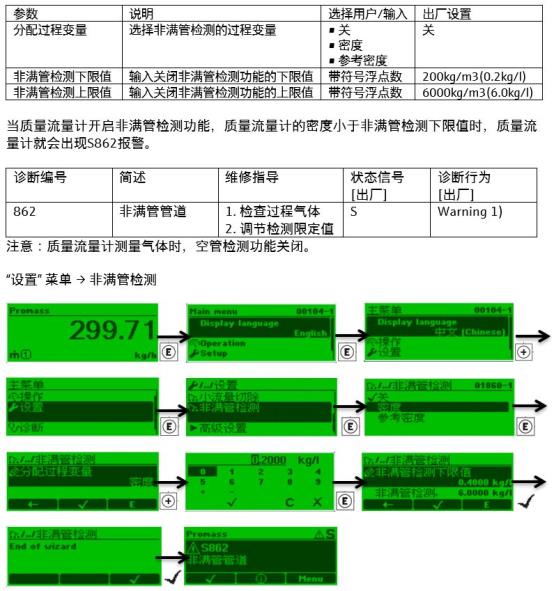
To enable empty pipe detection on the Promass 300/500, operation is required through the local display or commissioning software (such as FieldCare, DeviceCare). The following are general steps:
- Enter the main menu and select Setup → Advanced setup.
- Select the Empty pipe detection option.
- Set Empty pipe detection to On.
- According to the medium characteristics, adjust Empty pipe detection sensitivity; the default value is medium.
- Set Empty pipe detection response time, usually 1~5 seconds.
- Save the settings and exit; the instrument automatically applies the new parameters.
After enabling, it is recommended to perform an empty pipe simulation test to verify whether the alarm output is normal.
Key Parameters and Recommended Settings
Under different working conditions, empty pipe detection parameters need to be adjusted appropriately. The following table lists common parameters and recommended values:
| Parameter | Description | Recommended Value/Range |
|---|---|---|
| Empty pipe detection | Empty pipe detection switch | On / Off |
| Sensitivity | Detection sensitivity | Low / Medium / High |
| Response time | Alarm response time | 1~5 s |
| Empty pipe detection mode | Detection mode | Standard / High sensitivity |
The higher the sensitivity, the easier it is to trigger an empty pipe alarm, but false alarms may also occur due to bubbles or vibration. It is recommended to select according to the gas content of the medium and pipeline vibration conditions.
Common Issues and Precautions
Handling False Alarms
- Check whether the pipeline is indeed empty or not completely filled.
- Confirm whether the medium contains a large amount of bubbles; if necessary, reduce sensitivity.
- Check sensor cable shielding and grounding to avoid electromagnetic interference.
Unable to Enable Empty Pipe Detection
- Confirm that the instrument model supports this function (both Promass 300/500 support it).
- Check whether it is in safety lock or expert mode, which requires a password.
- Confirm that the measuring tube is not damaged and the sensor signal is normal.
Regularly performing zero point calibration and empty pipe detection verification can ensure long-term stability. If the on-site working conditions are complex, it is recommended to contact Endress+Hauser technical support for parameter optimization.