
T-mass 65 Quick Setup and Commissioning Overview
T-mass 65 is a thermal mass flowmeter launched by Endress+Hauser that can directly measure gas mass flow without additional temperature and pressure compensation. This article is intended for engineering technicians and procurement personnel, outlining the key steps for quick setup and commissioning. Proper commissioning can significantly improve measurement accuracy and long-term stability.
Preparation Before Commissioning
Installation and Wiring Check
- Confirm that the sensor installation direction matches the flow direction arrow, and that the straight pipe section meets the requirements of 10D upstream and 5D downstream.
- Check the sealing of the process connection to avoid leakage affecting mass flow measurement.
- Verify the supply voltage and wiring terminals to ensure they comply with the nameplate parameters.
Parameter Confirmation
Before commissioning, it is necessary to clarify the measured gas type, pipe diameter, range, and output signal type. These parameters directly affect the calibration coefficient and measurement accuracy.
Quick Setup Steps
Operating Procedure
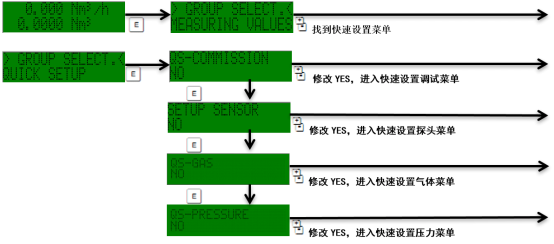
- After power-on, enter the local display menu and select the Quick Setup wizard.
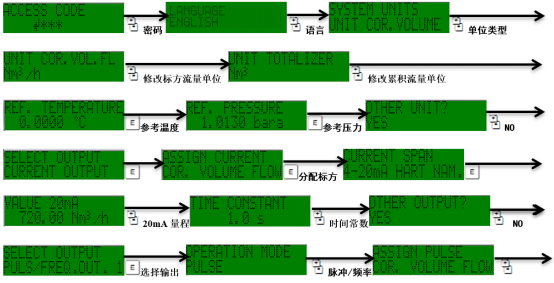
- Enter the gas type, pipe diameter, and upper and lower range limits in sequence.
- Set the output signal (4-20mA/pulse/frequency) and alarm thresholds.
- Save the parameters and exit, and confirm that the displayed value is stable.
Key Parameter Reference
| Parameter Item | Typical Setting | Description |
|---|---|---|
| Gas Type | Air/Nitrogen/Natural Gas, etc. | Affects the calibration curve |
| Turndown Ratio | 100:1 | Ensures low-flow accuracy |
| Output Signal | 4-20mA | Corresponds to mass flow |
| Damping Time | 1-5s | Suppresses fluctuations |
Zero-Point Calibration and Verification
Perform zero-point calibration under the condition that the pipe is full and there is no flow, which can eliminate the effects of installation stress and temperature drift. After calibration, introduce standard gas or compare with working conditions for verification, and the deviation should be controlled within the allowable range.
Common Problems and Troubleshooting
- Reading too low: Check for insufficient straight pipe section or sensor contamination.
- Zero-point drift: Re-execute zero-point calibration and confirm there is no leakage.
- Abnormal signal: Verify wiring and output configuration, and eliminate electromagnetic interference.
After completing the above steps, the T-mass 65 can be put into stable operation. Regular maintenance is recommended, and commissioning parameters should be recorded for future traceability and optimization.