
Overview of Common Circuit Switch Types
A circuit switch is a control component responsible for opening and closing circuits, and is widely used in industrial automation, household appliances, and electronic equipment. Depending on the number of poles and throws, common types include SPST (Single-Pole Single-Throw), SPDT (Single-Pole Double-Throw), DPST (Double-Pole Single-Throw), and DPDT (Double-Pole Double-Throw).
Understanding the circuit logic and terminal configurations of these four switches helps engineering technicians select the correct model, and procurement personnel can also match actual load requirements accordingly.
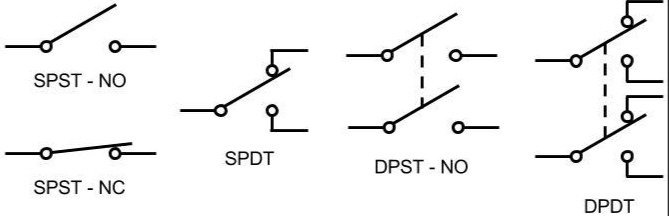
Structure and Working Principles of the Four Switches
SPST (Single-Pole Single-Throw)
SPST is the simplest type of circuit switch, with only two terminals: one input and one output. When the input and output are connected, the circuit is on; when disconnected, the circuit is off.
- Number of terminals: 2
- Circuit paths: 1
- Features: Simple wiring, low cost
SPDT (Single-Pole Double-Throw)
SPDT has one input and two outputs, totaling three terminals, and can switch between two circuit paths. At any given moment, the input can only connect to one output, while the other output remains disconnected.
- Number of terminals: 3
- Circuit paths: 2 selectable
- Features: Can achieve signal or load switching
DPST (Double-Pole Single-Throw)
DPST is equivalent to two SPST switches combined together, with two sets of independent inputs and outputs, and can simultaneously control the on/off of two circuit paths.
- Number of terminals: 4
- Circuit paths: 2 independent
- Features: Two sets of contacts can be independently isolated
DPDT (Double-Pole Double-Throw)
DPDT has a total of 6 contacts, divided into two groups, each with one input and two outputs, structurally equivalent to two SPDT circuits combined. It can simultaneously switch two independent circuits, enabling more complex control logic.
- Number of terminals: 6
- Circuit paths: 2 groups × 2 selectable
- Features: Flexible control, suitable for complex switching
Comparison of Parameters of the Four Switches
| Type | Number of Terminals | Circuit Paths | Typical Load Capacity | Common Applications |
|---|---|---|---|---|
| SPST | 2 | 1 | Low to medium | Lighting, fan switches |
| SPDT | 3 | 2 selectable | Medium to high | Mode switching, motor reversal |
| DPST | 4 | 2 independent | Medium to high | Dual-channel start/stop, safety isolation |
| DPDT | 6 | 2 groups × 2 | High | Signal gating, test equipment |
Typical Applications of Various Switches
Applications of SPST Switches
SPST switches have a simple structure, are easy to install, and have low manufacturing costs, making them suitable for large-scale production. Due to fewer internal mechanical and electrical parts, they have high reliability and long service life, and are also simple to maintain.
- Ordinary household wall switches
- On/off control of lamps and fans
- Power switches for simple electronic devices
Applications of SPDT Switches
SPDT switches are more flexible than SPST, can switch between two circuit paths, and can achieve mode selection or signal switching. They have relatively high current withstand capability and can operate at higher voltages and currents.
- Gear adjustment or timer settings for household appliances
- Forward/reverse control of industrial motors
- Signal source switching for electronic equipment
Applications of DPST Switches
DPST switches operate reliably and generally do not fail easily, making them suitable for basic control circuits. Each set of contacts can be independently electrically isolated, which helps ensure safe operation and circuit isolation.
- Start/stop control of simple circuits
- Signal source selection for communication equipment
- Industrial occasions requiring dual independent control
Applications of DPDT Switches
DPDT switches can control two completely independent circuit paths, providing more complex control and diverse operation options. They can withstand higher currents and longer working times, making them suitable for high-current capacity applications.
- Selecting different circuit configurations in laboratories or test equipment
- Switching antennas or signal receiving sources for communication equipment
- Professional equipment with high power or special requirements
Selection Recommendations
When selecting a circuit switch, comprehensive consideration should be given to the number of circuit paths, load current and voltage, installation space, and operating frequency. SPST is suitable for simple on/off, SPDT is suitable for switching selection, DPST is suitable for dual-channel isolation control, and DPDT is suitable for complex signal switching.
For procurement personnel, it is recommended to confirm the switch's rated current, voltage, and contact material according to the actual load type and safety requirements to ensure long-term stable operation.